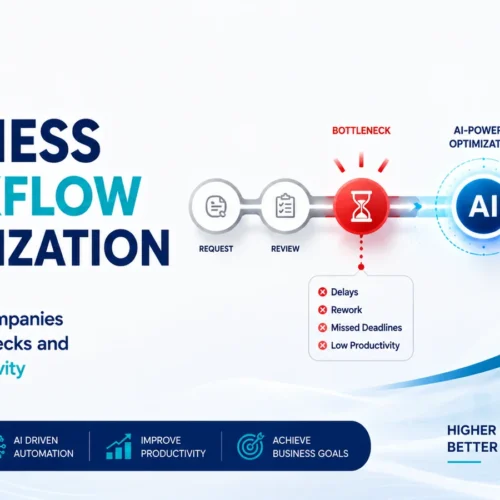
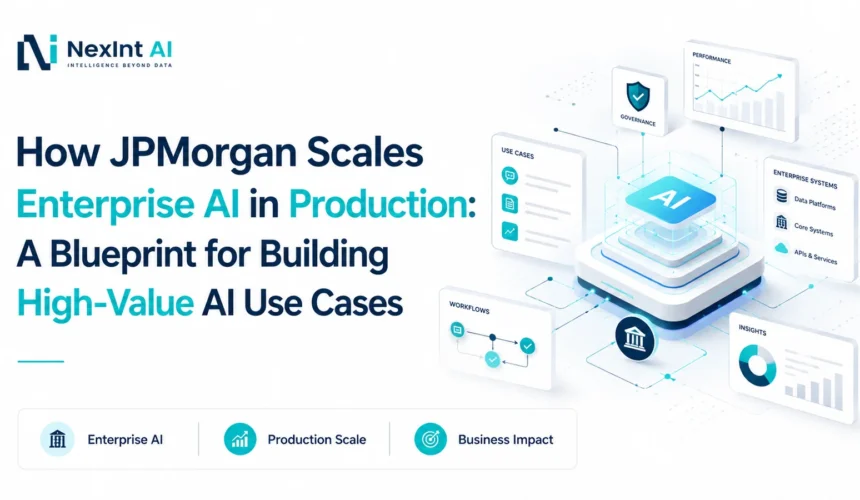
Many companies can build an AI demo. Far fewer can turn it into a production workflow that employees use, with access to reliable data, measurable value, and governance that scales beyond one team.
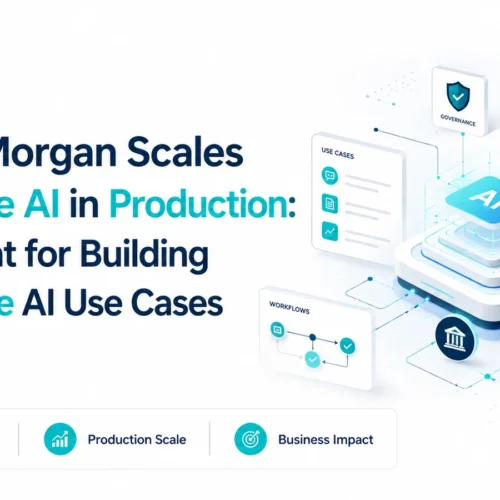
JPMorgan is a useful case because its AI journey spans traditional machine learning, document intelligence, generative AI, and now specialized Enterprise AI Agents. The lesson isn’t “deploy as many agents as possible” it’s to repeatedly find narrow workflows where AI has a clear, measurable job to do, a principle any serious AI Agent Development or Enterprise AI Automation effort should take seriously.
What JPMorgan’s AI Journey Actually Shows
JPMorgan has invested in AI for more than a decade. Its Commercial & Investment Bank reported in its 2024 Annual Report that the division had grown to over 175 AI use cases in production, with large parts of the team using an internal large language model platform.
That figure describes the CIB specifically, in that reporting period not every AI initiative firmwide, and not all of it agentic. It’s worth distinguishing a machine learning system, a generative AI assistant, an AI workflow, and true Enterprise AI Agents. JPMorgan’s portfolio includes all four, at different levels of autonomy.
Lesson 1: Start with a Narrow Business Problem
“Use AI to improve operations” is not an objective, it’s a wish. “Extract defined contractual attributes from a specific document type” is.
JPMorgan’s Contract Intelligence platform, known as COiN, is the clearest historical example: a narrow-scope machine learning system, not a modern generative AI agent, built around one workflow, one user group, and one measurable output. That narrowness is what made evaluation, training, governance, and ROI measurement tractable; the same discipline still applies to any AI Agent Development project or Enterprise AI Automation effort today.
The COiN Example: Why Measurable Workflows Win
According to JPMorgan’s 2016 Annual Report and subsequent reporting, COiN analyzed approximately 12,000 annual commercial credit agreements, extracting around 150 relevant attributes in seconds work that had previously consumed up to 360,000 manual review hours a year.
The shape of the use case is what matters: a defined “before” (manual review), a defined task, a structured output, and a measurable “after” (extraction in seconds). That shape is what any AI Agent Development effort should aim to replicate, regardless of industry or scale.
Lesson 2: Build on Clean and Accessible Data
No amount of model sophistication compensates for inaccessible or unreliable enterprise data. Data quality, clear definitions, ownership, integration, lineage, permissions, and freshness all determine whether an AI system can do its job.
JPMorgan’s continued investment in modern cloud and data infrastructure underpins its AI initiatives. The principle is simple: AI architecture starts with data architecture, which is exactly where data engineering work matters before any agent gets built.
Lesson 3: Measure the Before-and-After
Establish a baseline before deploying anything: time the workflow takes today, cost in capacity consumed, quality as correction frequency, and throughput and user experience.
Track whether faster completion affects revenue, risk, or customer experience. Without this baseline, no one can honestly say whether a deployment improved anything.
What Modern AI Agents Add
Traditional machine learning follows a simple path: Input → Model → Prediction.
Modern Enterprise AI Agents follow a different one: Goal → Reasoning → Tool Selection → Enterprise Systems → Action → Feedback.
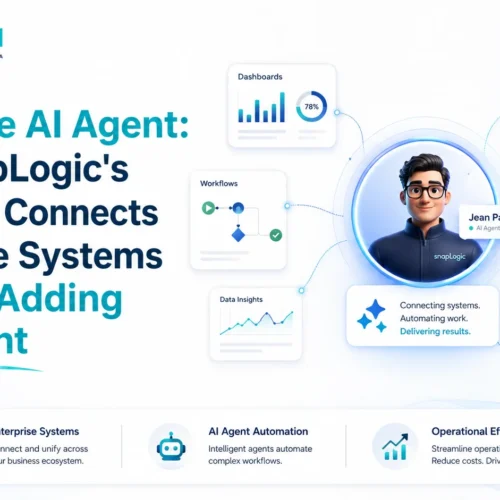
That shift introduces tool calling, API access, orchestration, and memory plus the need for approvals and runtime governance that a static prediction model never required, which is a core part of mature Enterprise AI Automation.
JPMorgan’s Connect Coach: Specialized Agents Instead of One Giant Agent
JPMorgan’s 2025 Annual Report describes Connect Coach, an Asset & Wealth Management tool built around 25 specialized AI agents that proactively deliver personalized outreach ideas to advisors, reportedly generating 1 million custom AI-driven insights delivered to roughly 5,000 Global Private Bank users in real time.
This is one specific, well-documented example not a claim about JPMorgan’s broader architecture but it illustrates a useful AI Agent Development principle: multiple bounded, specialized agents can handle defined tasks rather than one universal agent trying to understand every workflow.
Narrow Agent vs General Enterprise Agent
A general agent attempts to search everything and serve many departments scope and governance become difficult fast. A specialized agent is designed for specific users, data, tools, and permissions. Scope is a security control as much as a product decision, which is why most successful Enterprise AI Automation programs start narrow rather than broad.
Security Changes When AI Can Act
Traditional AI mostly provides information; agentic AI may act, introducing risk around tool access, delegated authority, and auditability.
Safeguards should scale with capability: read-only agents carry lower risk, approval-gated agents propose actions for human confirmation, and autonomous agents require the strongest controls.
This isn’t compliance advice, it’s a general principle for aligning governance to what any of these Enterprise AI Agents are allowed to do.
The Enterprise AI Production Blueprint
Find high-friction, repetitive work, then narrow the scope by defining the exact user, input, task, and output.
Establish a baseline across time, cost, volume, and accuracy, and audit the data for quality and permission issues. Choose the simplest appropriate pattern ML, LLM, RAG, an agent, or plain workflow automation without forcing an agent where simpler automation works.
Define success criteria before building, build the smallest production-useful version, evaluate failure cases, add governance, and scale by reusing connectors and evaluation patterns rather than starting over each time.
How to Choose the Right First Enterprise AI Agents Use Case
Good starting use cases are repetitive, high-frequency, time-consuming, clearly measurable, supported by accessible data, limited in scope, and easy to verify.
Document analysis, internal research, account preparation, and knowledge retrieval are common examples of early Enterprise AI Automation targeting general illustrations, not confirmed JPMorgan-specific use cases.
When NOT to Build an AI Agent
Skip the agent when deterministic rules already solve the problem, when data is unreliable, or when permissions can’t be safely enforced. Use the least complex technology that reliably solves the business problem. Sometimes that’s an agent, often it’s simpler automation.
How Enterprises Should Measure AI Agent ROI
Track productivity as hours saved, throughput as additional work completed, and quality as reduced rework.
Include revenue only where a credible link exists and always account for the operating cost of any Enterprise AI Automation effort model and API usage, infrastructure, and ongoing monitoring.
A useful framing: Net AI Value = Measurable Business Benefit − Total Operating and Implementation Cost. No credible AI Agent Development partner promises guaranteed ROI, and neither should this one.
What Mid-Size Enterprises Should Copy and What They Shouldn’t
Copy narrow use-case selection, strong data foundations, measurable baselines, and reusable components. Don’t copy JPMorgan’s technology budget or organizational complexity wholesale; the method scales down even when the budget doesn’t.
How NexInt AI Solutions Can Apply This Blueprint
NexInt was not involved in JPMorgan’s AI programs; they’re discussed here purely as a public, well-documented example.
Where NexInt’s own capabilities map to this blueprint: AI Agents & Automation for building bounded Enterprise AI Agents around specific workflows, Generative AI & LLMs for reasoning and language-intensive tasks, and Data Engineering for preparing reliable data underneath any of it. AI Product Development carries a use case from Discovery & Scoping through Build & Launch the same practical path any serious AI Agent Development effort follows:
Business Problem → Data Foundation → AI Pattern → Production Workflow → Evaluation → Governance → Scale.
Frequently Asked Questions
01.
How does JPMorgan use AI in production?
02.
What is JPMorgan's COiN system?
03.
What is an enterprise AI agent?
04.
How should a company choose its first AI agent use case?
05.
What data is needed for Enterprise AI agents?
Conclusion
Enterprise AI success isn’t about having the largest number of models or agents, it’s about finding narrow workflows where reliable data, a clear AI task, and measurable business outcomes come together.
Narrow problem, clean data, measurable baseline, the right architecture, governed deployment, then reuse what works.
If your organization in Chennai, Tamil Nadu, or anywhere in India is exploring Enterprise AI Agents, serious AI Agent Development, or broader Enterprise AI Automation, talk to NexInt AI Solutions about where to start.