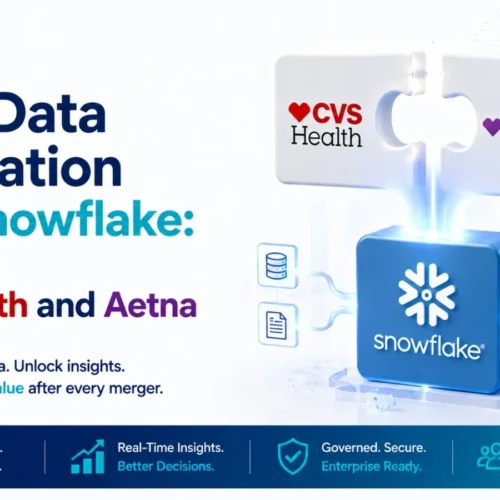
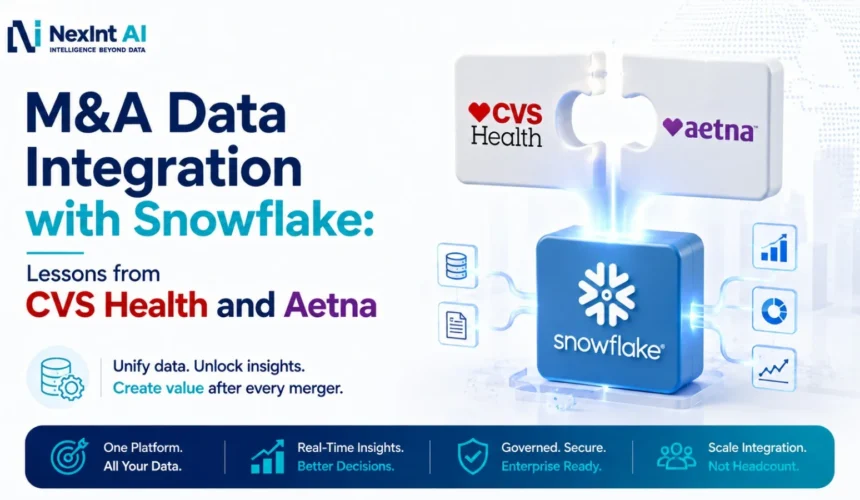
Signing an acquisition agreement is often easier than putting the data that belongs to the deal. Each of the two companies may still run its ERP system, its own CRM platform, its own data warehouse, its own customer IDs and its own rules for data. None of that changes when the legal deal closes. M&A Data Integration decides if the new company can work from one set of data or if it will spend years running on two separate data sets. The purchase of Aetna, by CVS Health is an example of this challenge and the Snowflake-based data engineering that CVS Health uses shows how a modern data platform can fit into the solution.I have seen how SnapLogic built Jean-Paul. It is a useful example for anyone planning an Enterprise AI Agent. Many AI assistants can answer a question but enterprise workers need more. They want an assistant that can read the CRM, check support tickets, pull usage data and deliver one report instead of opening four browser tabs of raw information. The gap between a chatbot and a true Enterprise AI Agent is rarely about the intelligence of the model; it is about granting access to the systems, tools, workflows and permissions that work together. This is the point where Internal AI Agent projects either succeed or stall. SnapLogic set out to prove this idea with its agent, Jean-Paul. Before any organization starts AI Agent Development, the Jean-Paul story is worth studying because it shows what a connected governed agent can do whether the enterprise sits in Chennai, Tamil Nadu or else builds an AI roadmap.
What Changed When CVS Health Acquired Aetna
CVS Health completed its acquisition of Aetna on November 28, 2018 combining CVSs pharmacy, pharmacy benefit management and retail health footprint with Aetna’s health insurance and benefits business in a transaction valued at $78 billion including assumed debt. In its completion announcement CVS Healths leadership described plans to bring together Aetna’s medical information and analytics with CVS pharmacy data to support more connected consumer-focused care. That statement matters here because it shows data was part of the acquisitions thesis, from day one. And its a very public example of why Post-Merger Data Integration becomes an immediate priority the moment two large organizations combine. Legally the businesses are one; operationally their information usually is not.
Why M&A Data Integration Is Harder Than It Looks
Post-merger teams rarely face a System A to System B migration. M&A Data Integration involves schemas that store the idea in different ways business definitions where “customer” or “member” means something different in each company duplicate records for the same person years of legacy history inconsistent governance and regulatory constraints especially, in healthcare that limit how data can be combined all while both companies keep operating. This is why M&A Data Integration is a design problem and a migration problem second.
The First Mistake: Trying to Move Everything at Once
The common failure after a merger is to start with the idea of moving all data into one place. Instead a merger should begin by answering the business questions that leaders need. Leaders need reporting, a shared customer or member view and combined operational visibility. Data consolidation that starts with technology not, with business priorities often ends up with costly platforms that no one trusts because the definitions of data were never aligned from the beginning.
A Reference Architecture for Post-Merger Data Integration
This is a template for Post-Merger Data Integration work. The template does not describe CVS Healths architecture because that level of detail has not been released. Source systems from both companies feed a data ingestion layer that is built from batch pipelines change data capture and APIs. Data first lands in a zone that keeps its original meaning. Then a standardization layer normalizes formats, codes and identifiers. A shared business data model then defines entities like customer, product and location. An enterprise data platform such as Snowflake can support the resulting workloads. Snowflake feeds BI, analytics and AI consumption layers all wrapped in governance that covers ownership, security and lineage. Snowflake’s own documentation describes support for scalable storage and compute, across structured and semi-structured data plus secure data sharing. These capabilities are broadly relevant here independent of any CVS Health implementation.
Migration, versus Integration After an Acquisition
Let me explain how this works after an acquisition. Data Consolidation programs usually need both migration and integration as part of a Post‑Merger Data Integration effort. Integration. Combines information so that integration can be analyzed together often while source systems keep running. Migration physically moves a workload to an environment. A workable sequence: first integrate for reporting then decide which redundant systems can retire and finally migrate the workloads that are worth moving.
The Identity Problem: Who Is the Same Customer?
After any acquisition the same customer may appear as Company A’s customer number and as Company B’s member number, with different names or contact details. Fixing the customer issue requires master data management, matching rules and a golden record strategy. In industries such, as healthcare the same customer work must respect privacy limits instead of just merging every matching field. It needs data engineering, not a quick fix tool.
Why Governance Has to Start Before Consolidation
Centralizing data before deciding who owns it how it is classified and which system is the one just creates a bigger less controlled platform. Data Consolidation without governance increases confusion of fixing it. Ownership, classification, access control and lineage must be part of the target architecture, from the beginning not added.
What the Aetna Deal Teaches About Data
Read these architecture choices form a repeatable pattern for Post-Merger Data Integration, not a one-time fix unique, to a single company.Three lessons carry over to large acquisitions. First data integration was explicitly part of the deal thesis. CVS Healths own announcement described integrating Aetna’s medical information and analytics with pharmacy data to support more connected care. Second the value comes from separate information supporting a more complete permitted view of the business not from copying every table into one warehouse. Third technology work continues after close: current CVS Health job postings reference Snowflake, dbt and SQL-based pipelines as part of its present-day platform. Evidence of ongoing investment though not proof the environment was built specifically because of the Aetna deal.
A Practical M&A Data Integration Plan
- Take stock of all data sources. Platforms, pipelines, applications and the people who own them.
- Start with the important business needs not try to do everything at once.
- Create a data dictionary so that terms have the same meaning everywhere.
- Sort out which data is sensitive and make sure it follows rules and agreements.
- Match up people and things from both companies so they can be connected.
- Decide what will stay what will be connected what will move and what will be removed.
- Make pipelines that can be used again by building separate links for each report.
- Check the quality of the data by looking at numbers, totals and how the business works.
- Move data in steps based on what matters not all at once.
- Get rid of systems on purpose, not just keep them running side by side.
This process makes sure that data integration during M&A is connected to business value at every stage, not just seen as one big technical move.
Common Mistakes to Avoid
- Migrating before understanding the data
- Assuming that matching field names mean matching definitions
- Building hundreds of one-off pipelines of a reusable layer
- Skipping master data management
- Pooling sensitive data, without proper governance
- Measuring migration completion instead of business adoption
Frequently Asked Questions
01.
What's M&A Data Integration?
02.
What is the difference between data migration and data integration?
03.
How can Snowflake support post‑merger data consolidation?
04.
How should companies integrate customer data after an acquisition?
05.
How long does post‑merger data integration take?
Conclusion
A merger joins two companies on paper. The data architecture decides whether the two companies can truly work as one. Successful programs do not start with ‘move all the data’. Successful programs start with business priorities, shared definitions, governance and a target architecture. After that do they move to integration and migration. CVS Healths purchase of Aetna is a real‑world example of why cross‑business Data Consolidation becomes strategically valuable and Snowflake shows one way modern enterprise data platforms can help with cross‑business Data Consolidation work when the architecture is right.