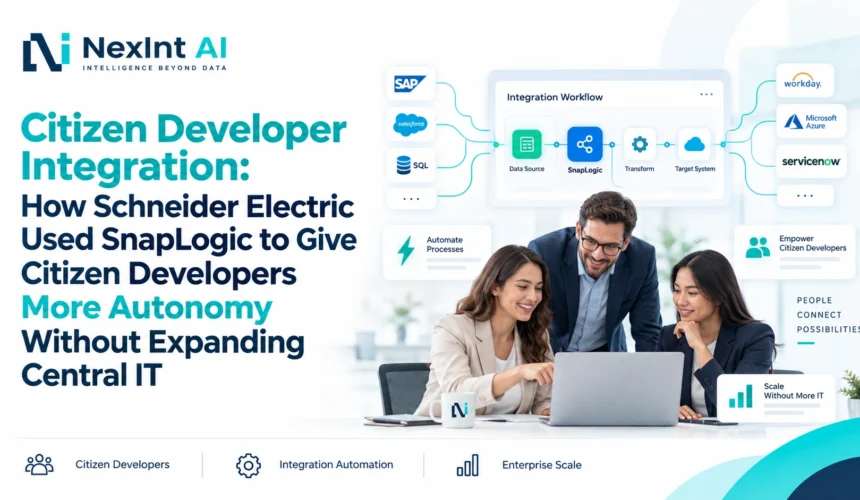
A manufacturing company may have systems that need to share data. Operations wants a workflow. Finance wants another application linked. The supply chain wants data access. All requests go to the central integration team. The actual bottleneck is not technology; it is the operating model. Citizen Developer Integration is a way for companies to rethink that model. Schneider Electric used SnapLogic in an example that shows this. The lesson is not to let business users build anything they desire. Instead it is to provide governed self‑service integration skilled business users can solve approved problems without making central IT build every pipeline.
The Integration Bottleneck Schneider Electric Was Trying to Solve
According to the case study from SnapLogic’s official case study, a global energy and automation company that employs more than 135,000 people in more than 100 countries used to depend on a single Professional Services team to create applications and integrations for business groups around the world. As the need grew that approach became heavy on resources and slow. This is a pattern in manufacturing settings, where ERP, supply chain, finance and reporting systems must all communicate and every request competes for the same limited specialist capacity. Citizen Development became Schneider Electric’s solution to that scaling issue.
What Schneider Electric Changed
Schneider Electric did not get rid of IT oversight. Instead Schneider Electric changed the way integration work is actually delivered. The company started using a tiered model with three levels of support. First there is Close Support, which gives citizen developers step-by-step help. Then there is Light Support, where business users build things with a little help while the central team stays ready to fix architectureAutonomous or troubleshooting issues. Finally there is support, where experienced and certified citizen developers build things with almost no help. All citizen developers must follow rules for architecture, design, cybersecurity and data governance. This is the secret to a good SnapLogic Integration program. You give people freedom. That freedom stays inside a governed technical framework. It is not freedom of a framework. This is a way to plan any Citizen Developer Integration rollout, no matter which platform you use.
The Architecture Behind Safe Citizen Developer Integration
I want to share a model for how this works though this is not a claim about the exact internal architecture of Schneider Electric. This model uses five layers. At the bottom you have your enterprise systems like ERP, CRM, finance and SaaS platforms. Above those systems sits an integration platform layer. In this layer an iPaaS like SnapLogic provides things like connectors, pipelines and transformation logic. Then a governance layer sits on top to define connectors, security rules and naming conventions. Citizen developers work within those boundaries. Finally a monitoring layer keeps IT able to see failures, usage and production behavior. Any organization that is piloting SnapLogic Integration or a similar platform will benefit from thinking in these layers before they give access to business users. To me the platform choice matters less, than the discipline wrapped around the platform.
Why Citizen Development Does Not Mean Removing IT
Central IT still owns platform administration, security, architecture standards, production controls and complex or high-volume integrations. I believe it is important to remember that citizen developers can take on tasks. Depending on training and risk tolerance citizen developers can own department-level integrations, approved SaaS connections, repetitive data movement and local process automation. Strong Integration Governance is what decides where that line sits. There is no rule that applies to every company so Strong Integration Governance helps make those choices.
What the Case Study Said
SnapLogics written information says that Schneider Electric allowed 150 citizen developers to connect more than 100 systems across departments such as Finance, Marketing and Supply Chain. Jamie Locks, VP of Integration and Middleware at Schneider Electric is mentioned as saying that citizen developers are more productive and independent with development costs and less need for special resources. No specific number is given in the original information so no number should be assumed.
Adapting the Model for Mid‑Size Manufacturers
A 500‑person manufacturer should not try to copy a 135,000‑person enterprise. The principle can scale down well. I feel that starting with three to five employees who are close to the business process is a good idea, not a company‑wide rollout. I would start with tasks such as reporting feeds, approved SaaS syncs and internal data movement. Keep ERP regulated data integrations under the strict control of central IT. Create templates in a central location so that citizen developers can adapt them instead of building from scratch. Also set escalation rules for when a request must go back to a specialist. This is what determines whether Manufacturing Integration programs succeed or fail. The success does not depend on the tools but on how the rollout is sequenced. Mission‑critical production integrations, sensitive financial workflows and complex master data scenarios should remain with specialists no matter how mature the program becomes. Manufacturing Integration programs will only thrive if the rollout is carefully planned and executed.
Common Mistakes to Avoid
The common mistake people make is giving platform access without any rules. Another big mistake is letting citizen developers work on mission- workflows right away instead of starting with low-risk ones. If you skip a training or certification path, never build patterns or do not have a production review process you will hurt your Citizen Developer Integration program before it even starts. I also want to point out that the goal of a Citizen Developer Integration program is to make delivery faster and safer. You should not just quietly give tasks to employees without giving those employees the right tools and help
Where NexInt AI Solutions Fits
NexInt AI Solutions was not part of the Schneider Electric project. I am only mentioning the Schneider Electric project here because it is an example for everyone to learn from. NexInt AI Solutions helps manufacturers and big companies by taking these lessons and applying them to their setups. NexInt AI Solutions designs the data engineering and the pipelines that a self-service model needs to work. NexInt AI Solutions also builds the governance and the architecture so that Citizen Development stays safe. NexInt AI Solutions supports SnapLogic Integration work when that tool is the choice for the job. All of this work happens alongside the NexInt AI solutions and product development work. Everything NexInt AI Solutions does follows the end-to-end ownership approach you can read about on the company’s about page.
Frequently Asked Questions
01.
What is a citizen developer in enterprise integration?
02.
How did Schneider Electric use SnapLogic for citizen development?
03.
Does citizen development replace integration specialists?
04.
How should a company choose its first AI agent use case?
05.
Can mid‑size manufacturers use the Schneider Electric model?
Conclusion
Schneider Electric’s experience shows that increasing the ability to handle integrations does not mean making one single team responsible for building all the connections. A better way is to make sure the rules are the same and let different groups handle parts of the work. Providing people who work in the business with the right tools, the right training, the right way to design things and a clear path to get help when needed. This is the idea behind good Citizen Developer Integration whether the system used is SnapLogic Integration or some other platform that helps with integration. If your team that works in manufacturing or in an enterprise setting in Chennai, Tamil Nadu or anywhere else, in India is thinking about a way to handle get in touch with NexInt AI Solutions h out to NexInt AI Solutions to discuss it.