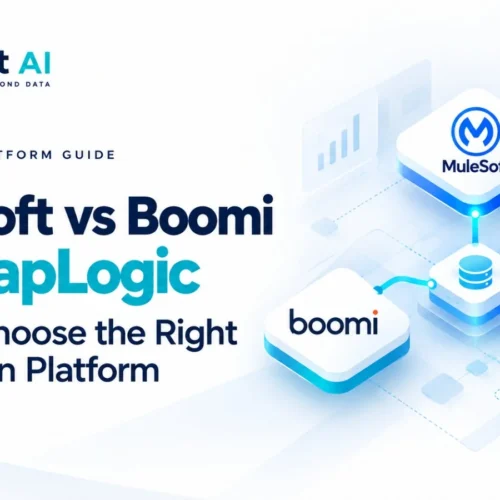

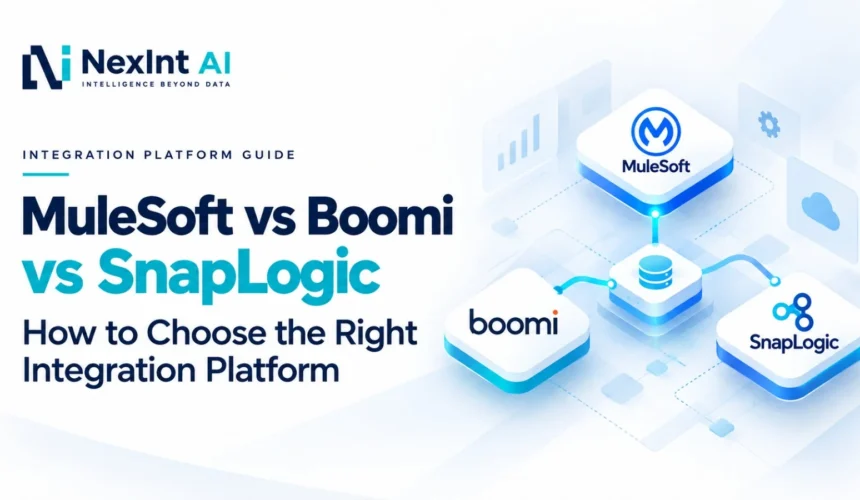
If you start your integration-platform search with a list of features you might already be asking the question. MuleSoft vs. Boomi vs. SnapLogic can each solve enterprise integration problems but each organization has its own architecture, governance needs and team skills.
A useful MuleSoft vs. Boomi, vs. SnapLogic evaluation starts from your integration platform comparison not from vendor marketing. This comparison of integration platforms walks through the requirements and operating factors that matter most when choosing an iPaaS platform for your enterprise.
MuleSoft versus Boomi, versus SnapLogic: The Short Answer
MuleSoft, Boomi and SnapLogic are enterprise integration platforms that have abilities but each has unique strengths. MuleSoft is worth looking at closely when API-led architecture and enterprise API governance’re important. Boomi is worth looking at closely for application connectivity, B2B and EDI and integration modernization.
SnapLogic is worth looking at where application and data integration come together with visual pipeline development. This integration platform comparison ultimately depends on workload, governance, skills and deployment needs. There is no answer that works for everyone.
First: What Problem Are You Actually Solving?
Before you start choosing an iPaaS platform comparing products take a look at the integration work your team actually needs to do.
Is it connecting applications?
MuleSoft vs. Boomi vs. SnapLogic Exposing APIs?
Transforming data?
Handling B2B or EDI exchanges?
Managing environments with on-premises systems?
Modernizing old legacy systems?
The key is to ask yourself what your organization truly needs to connect, control and run. Don’t pick a platform first. Then try to fit all your problems into its one-size-fits-all model. Choosing an iPaaS platform should start with an honest inventory of your integration needs.
MuleSoft: Where It Deserves Consideration
MuleSoft’s Anypoint Platform is built around API-led connectivity. This means it layers System APIs, Process APIs integration platform comparison and Experience APIs so that integration assets can be reused from being created from scratch for every new project.
Organizations that run API programs need strong governance or are deeply tied to the Salesforce ecosystem often take a close look at MuleSoft’s official API-led connectivity documentation. Today check MuleSoft’s official API-led connectivity documentation.
Boomi: Where It Deserves Consideration
Boomi is built to handle a wide range of integration and automation tasks in the cloud. It brings together application connectivity, B2B and EDI management, data integration and API management in one place. Companies MuleSoft vs. Boomi vs. SnapLogic that have different applications work with many trading partners or are updating older systems often look at Boomi carefully.
It’s a contender for organizations trying to modernize their integration setup. Check the Boomi platform overview to see the features and what the platform can do.
SnapLogic: Where It Deserves Serious Consideration
SnapLogic focuses on integration platform comparison making integration easy with a drag-and-drop approach. It uses pipeline-based tools where users can build data flows and connect applications step, by step.
The platform includes components and uses AI to help speed up development. For companies that need both data integration and application connectivity SnapLogic stands choosing an iPaaS platform out. It’s especially useful when teams want to work using low-code tools. If collaboration and fast pipeline creation matter SnapLogic is worth looking at.
Mistakes to Avoid When Choosing an iPaaS Platform
- Choosing from a feature checklist most enterprise platforms overlap heavily on paper.
- Judging by connector count. Connector depth for your objects and auth model matters more.
- Ignoring production operations. Monitoring, alerting and recovery matter more, than demo day.
- Running a proof of concept. A single “Hello World” integration proves very little.
- Letting vendor demos define your use cases. Test your difficult representative scenarios.
A Practical Path to a Decision
A path to a decision can be built on a simple framework. First inventory the integration landscape. Next identify the patterns such as application, API, data, B2B and hybrid. Then define governance MuleSoft vs. Boomi vs. SnapLogic and architecture needs. Assess the skills of the team. Model the cost of ownership beyond just licensing.
Finally run proofs of concept before making a choice. Weight the criteria according to your requirements, not the recommendations of vendors or articles.
How AI Solutions Helps
NexInt AI Solutions partners with integration platform comparison enterprises, on data engineering, pipeline development, data migration and data platform architecture. These are the areas that support a good integration platform decision.
NexInt AI Solutions does not push a platform. Instead it first maps the real integration landscape as part of a comparison. You can learn more on the NexInt AI Solutions website read ideas on the NexInt blog, or read further integration and data engineering articles before beginning an evaluation. For architecture‑specific discussions the NexInt team can walk through the requirements. You can also reach out directly through the NexInt contact page to plan an evaluation.
Conclusion
MuleSoft, Boomi and choosing an iPaaS platform SnapLogic are not the same. None of them is automatically the best integration platform if you do not understand the environment where MuleSoft will run where Boomi will run or where SnapLogic will run. Choose the platform only after you know your integration landscape not before. That order is the challenge of picking an iPaaS platform.
If your main need is API governance, wide application and B2B connectivity or both data and application pipelines this MuleSoft vs. Boomi vs. SnapLogic comparison is a good first step for a decision that starts with your needs. It can be backed, when necessary by the work of NexInt AI Solutions with companies, in Chennai, Tamil Nadu and elsewhere.