A pharmaceutical organization rarely has a data shortage. Research, clinical development, commercial teams, manufacturing, and external partners all generate valuable information. The challenge is making the right data discoverable, governed, current, and shareable across those boundaries without a maze of exports and database copies.
Novartis is a real-world example of how Snowflake Data Sharing can help address this, offering useful lessons for any organization building a more unified Life Sciences Data Platform.
The Data Challenge Novartis Was Trying to Solve
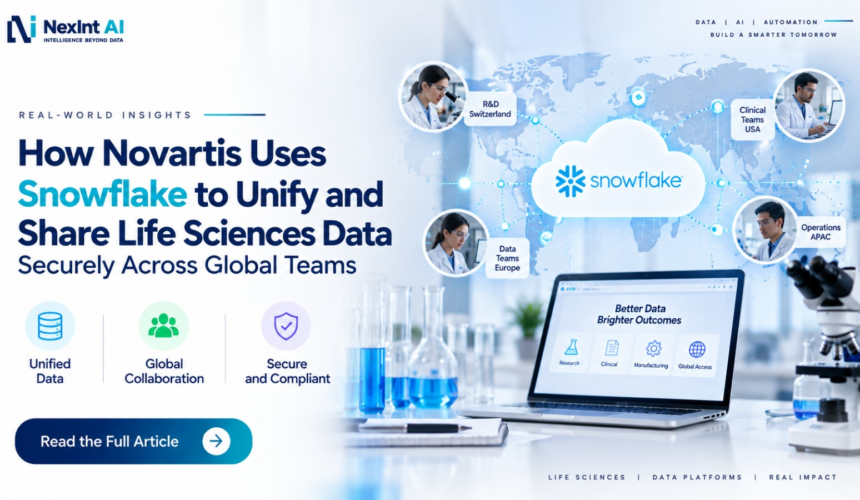
According to Snowflake’s published account, Ashish Sharma, Novartis’s Executive Director of Data and Platforms for Commercial Effectiveness, described needing to unite data scattered across many silos to generate the insights the business needed.
He noted that reaching meaningful insight from data could previously take three to six months, a figure attributed directly to Sharma, not a claim about every Novartis analytics workflow. Novartis first adopted Snowflake in 2017 as part of its broader “Formula One” digital initiative, later scaling into a more unified Life Sciences Data Platform across multiple clouds and regions.
Why Life Sciences Data Collaboration Is So Difficult
Sensitive information often carries strict handling requirements. Multiple organizations, sponsors, CROs, and technology partners need different access levels. Data residency introduces region-specific requirements that can’t be ignored.
Data copies multiply quickly through traditional sharing and become hard to synchronize. Different platforms across partners add friction, and data freshness becomes uncertain when teams can’t tell if information is current.
What Is Snowflake Secure Data Sharing?
Secure Data Sharing lets a data provider grant a consumer controlled, read-only access to selected database objects, without the consumer needing to copy that data into their own storage.
The flow: Provider → Share Approved Data Objects → Consumer Gets Controlled Read Access → Source Remains Governed by Provider.
This is the core mechanism behind Snowflake Data Sharing: for direct shares within the same region and cloud, the underlying data isn’t duplicated into a separate consumer environment, and the provider retains full control and can revoke access at any time.
Traditional Data Sharing vs Snowflake Secure Data Sharing
Traditional copy-based sharing CSV exports, SFTP transfers, database copies, scheduled ETL leaves organizations managing stale copies, extra storage, and more places data could go wrong. It isn’t always the wrong choice, but it adds operational overhead.
Snowflake Data Sharing can provide controlled access to approved data objects without creating the same kind of independent physical copies for direct, same region shares meaning fewer synchronization pipelines, more current data, and centralized provider control over who sees what.
How Cross-Region and Cross-Cloud Data Sharing Works
This is where nuance matters. Direct, no-copy sharing applies specifically to shares within the same region and cloud platform. For cross-region or cross-cloud collaboration across AWS, Azure, and Google Cloud, Snowflake’s own documentation explains that providers use database replication creating one governed copy per target region, not per consumer. It is not accurate to describe all global Snowflake Data Sharing as creating zero physical copies everywhere; the actual architecture behind any Secure Data Sharing setup depends on region, cloud provider, and applicable legal requirements.
How This Architecture Could Support Pharma Research Collaboration
The following are general industry applications, not confirmed details of Novartis’s specific implementation.
Clinical research collaboration could involve making approved datasets available to appropriate internal or partner teams under controlled access.
CRO collaboration often requires sponsors and research organizations to access selected datasets without full data transfers.
Research and scientific data at scale can benefit from elastic compute paired with controlled sharing.
Real-world evidence work often needs to combine internal and external datasets, and commercial analytics across global teams benefits from a common, governed Life Sciences Data Platform.
Why “No Copy” Matters for Life Sciences Data Teams
- Fewer duplicate datasets reduce storage sprawl and confusion about which version is authoritative.
- Less synchronization work frees engineering time from constant reconciliation.
- Better data freshness means consumers see current data, not last week’s export.
- Centralized access control keeps permission decisions in one place.
- Simpler revocation lets providers cut off access instantly when needed.
- Clearer data ownership avoids the ambiguity multiple copies create.
Security, Privacy, and Governance Still Matter
None of this removes an organization’s own governance responsibility. Role-based access, least privilege, secure views, data masking, classification, auditing, and residency requirements all still need deliberate design. Organizations must configure their architecture according to applicable regulatory and contractual requirements; a platform capable of secure sharing does not, by itself, create HIPAA, GDPR, or GxP compliance.
Data Sharing vs Data Clean Rooms: Which Does Pharma Need?
Secure Data Sharing fits scenarios where an approved consumer should directly access selected data. A Data Clean Room fits scenarios where organizations want to collaborate on analysis while restricting direct visibility into the underlying data itself. Pharmaceutical organizations may need either approach or both depending on data sensitivity, the partner relationship, and the analytical objective. There’s no public confirmation that Novartis uses a Snowflake Data Clean Room specifically, so broader Snowflake Data Sharing options remain a general architectural discussion rather than a claim about their exact setup.
What Pharma Data Teams Can Learn from Novartis
Unifying before you collaborate fragmented systems make external collaboration harder than it needs to be.
Treat data sharing as architecture, not manual exports.
Separate ownership from consumption consumers don’t always need their own copy.
Design for global operations by considering region and residency requirements early.
Build governance into the platform rather than adding it later.
Prepare for AI, since a governed, shared data foundation can later support analytics initiatives.
A 7-Step Secure Data Collaboration Blueprint for Pharma
Start by identifying the actual use case: what decision needs shared data? Classify the data by sensitivity and regulatory requirement, then identify who’s providing and who’s consuming. Minimize the shared dataset to only what’s genuinely required, and choose the right pattern: direct sharing, a listing, a data exchange, or a clean room. Implement governance around access and revocation, then monitor usage over time. No single architecture fits every pharma organization building a Life Sciences Data Platform.
Common Pharma Data-Sharing Mistakes
- Creating a new copy for every consumer instead of centralizing access.
- Sharing more data than needed, expanding risk unnecessarily.
- Ignoring data residency until a legal issue forces the question.
- Treating anonymization as a one-time checkbox rather than ongoing.
- No clear data owner, leaving accountability ambiguous.
- No access expiration or revocation process once a project ends.
Where NexInt AI Solutions Fits
NexInt was not involved in the Novartis-Snowflake implementation described here Novartis is presented purely as an external, publicly documented example.
Where NexInt can help is earlier in the journey: data engineering work to build reliable foundations for governed enterprise data, and pipeline development to integrate source systems before they reach any platform. The goal isn’t simply “move to a data cloud” it’s building reliable data sources and real governance for a genuine Life Sciences Data Platform, which later supports AI Solutions and broader AI Product Development once the foundation is ready.
Frequently Asked Questions
01.
1.What is Snowflake Secure Data Sharing?
02.
2.Does Snowflake Data Sharing copy the data?
03.
3.Can Snowflake share data across cloud providers?
04.
4.How can pharmaceutical companies securely share research data?
05.
5.What's the difference between Secure Data Sharing and a Data Clean Room?
Conclusion
Secure data collaboration in life sciences isn’t about moving data between organizations, it’s about giving approved teams access to the right governed data while minimizing unnecessary copies and uncontrolled sprawl.
Novartis’s experience shows what’s possible when fragmented data gets unified onto a platform built for controlled Snowflake Data Sharing, though the specific architecture any organization needs will differ.
If your pharmaceutical, biotech, or healthcare organization in Chennai, Tamil Nadu, or elsewhere in India is thinking about the data engineering and platform foundation behind a serious Life Sciences Data Platform strategy, talk to NexInt AI Solutions about where your data currently stands.