An employee who works at a company with 30,000 people has a question: how many days of leave are still available, which rule applies or if a request was already approved.
The answer is usually somewhere. In an HR portal a policy document or a ticketing system. But getting it means waiting for a person to find it. AMDs real-life use of an AI HR Assistant shows what happens when that search is replaced by one way to ask a question and get an answer directly from HR information and company systems.
The Challenge: Scaling HR Support without Scaling Friction
AMDs HR team was small compared to its reach. About 15 people, at the contact center who helped a global workforce spread across different regions and time zones.
Every simple question that needed a person caused a queue. As more staff joined, keeping response times fast and quality all day long got AI HR Assistant harder unless more people were hired. This was not a case of an HR team failing; it was a problem of scale and design that many fast‑growing companies face.
That is what Employee Self‑Service Automation is meant to fix. It gives employees a way to handle routine requests themselves in the same channel they already use before each question becomes a ticket.
The Solution: One HR AI Agent, Many Systems
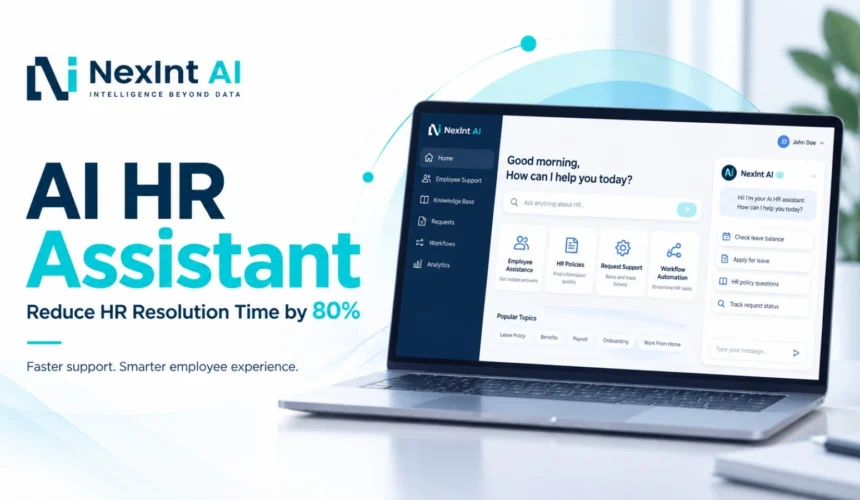
I saw how AMD teamed up with Kore.ai to put an HR AI Agent in place. The HR Agent gave employees and managers a way to get HR information and to handle many common tasks.By sending every question to a person the HR Agent lets users help themselves on everyday requests. It gave answers that fit the user’s role and location. Managers could approve actions directly inside Microsoft Teams AI HR Assistant and the HR Agent would forward more difficult or sensitive questions to a real HR person.
A special API layer tied SAP Success Factors, Service Now and Microsoft SharePoint behind that single chat door as Kore.ai’s official AMD customer story The HR Agent was useful not just because it could talk it was useful because it linked conversation to HR work.
Verified Results What AMD Actually Achieved
Kore.ai reports an 80 percent reduction in HR resolution time after the HR AI Agent went live meaning employees generally wait less and HR staff spend time on repetitive steps. Kore.ai also reports a 50 percent self-service deflection rate for AMDs deployment, a meaningful share of requests that no longer needed to enter the traditional support queue at all.That figure describes deflection not a claim that half of all HR work or headcount was automated. Alongside this Kore. Reports a 70% increase in employee satisfaction tied to faster lower friction support.All three figures are Kore.ai reported outcomes specific to AMDs environment, not universal benchmarks every organization should expect to match. In practice that’s the return a well scoped AI HR Assistant is expected to deliver fewer employees waiting in a queue and more HR capacity, for the exceptions that genuinely need a person
What HR Leaders Can Copy? Without AMDs Scale
The transferable lesson is not the percentage; it is the operating model behind genuine Employee Self-Service Automation.
Five practices can be adopted by organizations:
- Place the assistant inside a channel employees already use, such as Teams or an internal portal;
- Link it to governed current HR knowledge instead of scattered documents;
- Add role and region context so answers stay relevant;
- Allow HR AI Agent it to complete or route approved transactions instead of only answering questions;
- Maintain a clear human escalation path, for sensitive matters.
Measure resolution time and deflection not chat volume to show whether Employee Self-Service Automation and the wider AI Solutions are really reducing friction. NexInt AI Product Development process, moving from discovery and scoping through design, build and launch is built around scoping this kind of use case before wider rollout.
How This Maps to NexGPT
AMDs situation shows the issue that an AI HR Assistant is designed to fix: helping people get information through conversation instead of going through manual searches. NexInt NexGPT is a BI and data-intelligence layer that changes natural-language questions into secure controlled queries against company data. It runs inside the customers system using a non-training LLM setup.
That makes it a good choice for HR reporting and workforce-analytics questions like ticket numbers headcount changes and leave trends. These answers come in seconds of waiting for a report. It is not as it comes today a copy of AMDs full transactional HR Agent. Employee Self-Service Automation Linking NexGPT-style conversation access to policy content and systems such, as an HRIS or a service desk is exactly the kind of work that Da Data Engineering and workflow automation are meant to handle.
What the AMD Case Does Not Prove
AMDs numbers do not mean that HR AI Agent means that every company will see an 80 percent drop, in resolution time that fifty percent of cases will be handled by self‑service or that AI should replace HR teams.
AMDs numbers do not mean that NexGPT Employee Self-Service Automation automatically reproduces AMDs entire Kore.ai‑built system. The dependable part of the story is the architecture. One entry point, knowledge, employee context, connected workflows and human escalation. Not the specific outcome.
Where NexInt AI Solutions Fits
NexInt AI Solutions was not part of the Schneider Electric project. I am only mentioning the Schneider Electric project here because it is an example for everyone to learn from. NexInt AI Solutions helps manufacturers and big companies by taking these lessons and applying them to their setups. NexInt AI Solutions designs the data engineering and the pipelines that a self-service model needs to work. NexInt AI Solutions also builds the governance and the architecture so that Citizen Development stays safe. NexInt AI Solutions supports SnapLogic Integration work when that tool is the choice for the job. All of this work happens alongside the NexInt AI solutions and product development work. Everything NexInt AI Solutions does follows the end-to-end ownership approach you can read about on the company’s about page.
Frequently Asked Questions
01.
A few questions HR and IT leaders ask about deployments like AMDs:
02.
How is an HR AI Agent different from a chatbot?
03.
What systems does a setup like AMDs connect to?
04.
Does this kind of automation mean HR staff get replaced?
05.
Does this kind of automation mean HR staff get replaced?
Conclusion
AMDs case shows that a strong HR AI Agent creates value when it acts as the entry point to trusted information and company processes, not when it is added as just another separate chatbot.For companies thinking about an approach, a good first step is to look at current HR questions, improve the information that supports them and link one system before expanding to more Employee Self-Service Automation.NexInt AI Solutions works with businesses in Chennai, Tamil Nadu and India to figure out what an internal AI HR Assistant should be like for their team to discuss NexGPT and the whole system around it.