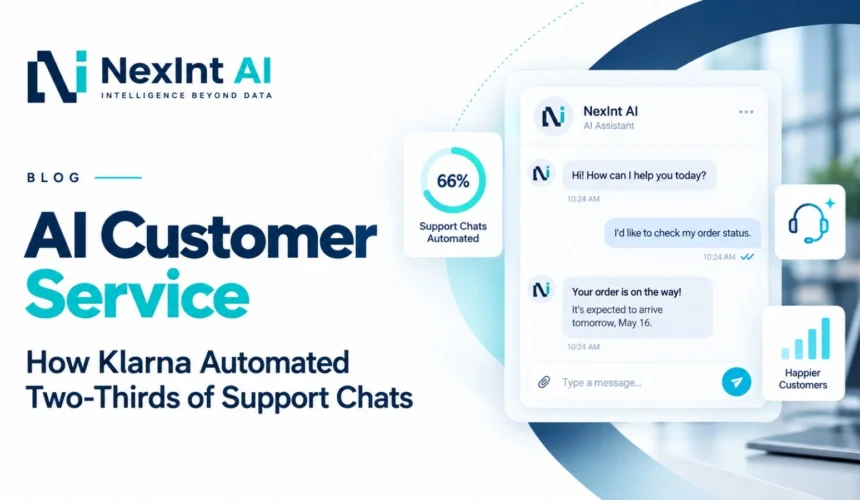
People often ask for a real‑world example of AI Customer Service done at scale. Klarna’s 2024 AI assistant is usually the answer. In February 2024 Klarna launched a support assistant built with OpenAI.Within a month the AI Customer Service system was handling two‑thirds of all customer service chats. This case study looks at what Klarna reported, why the numbers held up to scrutiny and what a mid‑size retail, e‑commerce or SaaS business can realistically borrow from the model without needing Klarna’s budget or scale.
The Challenge: Support at Global Scale
Before automation Klarna support faced a bottleneck that’s common for any company scaling Customer Service Automation. Klarna support received thousands of questions about payments, refunds and orders. These questions came from 23 markets and then 35 languages.Customers expected help even when normal business hours had closed. The hard part was not just generating a reply that sounded plausible. The hard part was delivering the answer, with the correct account context and deciding when a case required a human instead.
The Solution: What Klarnas Assistant Did
Klarnas AI Customer Service Agent Assistant could answer common questions, work in more than 35 languages and stay available around the clock. According to Klarna and OpenAI’s own case material Klarnas Assistant also handled Customer Service Automation.Authenticated account and order-related queries and escalated more complex cases to human agents. That is a different design from a basic FAQ bot, which simply maps a question, to a generic answer.A production-grade AI Customer Service Agent instead maps intent to approved knowledge and account context then resolves the case or hands it off cleanly. The same principle NexInt applies through its AI Solutions practice.
The Results: What Klarna Actually Reported
In its month of operation Klarna’s assistant handled 2.3 million conversations, which is about two thirds of all customer AI Customer Service Agent service chats. The company said this workload is similar to what about 700 full‑time agents would handle.That does not mean 700 people were fired. The average time to resolve a problem fell from about 11 minutes to less than 2 minutes. The number of repeat questions on the problem dropped by 25 percent, which suggests that more issues were solved on the first call. Klarna said that customers were as happy with the assistant as they were with agents.The company also estimated a profit gain of $40 million for 2024 a figure that comes from the AI Customer Service company itself and has not been independently verified. These numbers are why Klarna’s launch is often used as a benchmark, for customer‑service robots although the details need to look more than headlines usually give.
Why the Model Alone Wasn’t the Real Solution
A language model that does not have business context cannot reliably resolve support requests I think.What made the deployment work was the combination of parts: an AI model that understands AI Customer Service Agent language, business knowledge authorized customer context, integrations, escalation rules and ongoing monitoring.The model is the conversation layer; the enterprise data and guardrails that surround the model are what make an AI Customer Service deployment operationally useful of just a novelty chatbot. Building the data layer, cleaning the data, structuring the data and connecting the data safely is the kind of work that NexInt handles through its data engineering services.You might notice that skipping the groundwork causes even the best Customer Service Automation tooling to guess instead of resolving.
What Mid-Size Companies Should Copy
The lesson from Klarna isn’t “match our scale.” It’s a sequence any support team can apply:
- Identify your top 10 recurring support reasons from real ticket data
- Record a baseline: volume, resolution time, repeat contacts, escalation rate
- Clean up contradictory or outdated policy documentation before automating anything
- Connect one system first. For example order status. Before adding more
- Define clearly which situations must go to a human
- Pilot with a controlled audience then measure against the baseline before expanding
Good first candidates for Customer Service Automation are high-volume, repetitive and easy to verify. Order status, return policies, refund timelines and account FAQs. Workflows involving judgment, disputes or weak source data should stay with people until the basics are proven.
How NexInt AI Solutions Can Use This Model
NexInt did not take part in Klarnas rollout. This is a review of a public example for learning.The core pattern that NexInt uses for its own clients is: data support together with a governed knowledge layer, an AI Customer Service Agent that handles the chat secure links to order and account systems and a clear human hand‑off when needed.From the discovery, to a live pilot this build follows NexInt AI Product Development steps and most projects begin with a free AI audit to find where automation can truly benefit.
What Klarnas Case Does Not Prove
Klarnas numbers Customer Service Automation. Do not prove that every business can automate two-thirds of its support volume or that every company should expect a profit outcome.They do not prove AI should replace support. Klarna itself kept live agents AI Customer Service Agent in place, for complex cases. The transferable value here is the operating model, not the headline number: find demand, connect reliable data, automate a bounded workflow and keep a clear path to a human.
Frequently Asked Questions
01.
How did Klarna use AI for customer service?
02.
How much did Klarna save with its AI Customer Service Agent?
03.
Can a mid‑size company build something?
04.
How should a company choose its first AI agent use case?
05.
Customer Service Automation.
Conclusion
The valuable takeaway from Klarna is not the amount of savings they reported, it’s the way artificial intelligence was used in one particular, clear and high volume process.The model that can be copied is straight AI Customer Service forward: look for tasks that happen over and again, figure out the starting point, make sure the information is correct, link the important data, automate a limited process, have people available to take over when needed and grow only after the results show it works.If your team in Chennai, Tamil Nadu or any place in India is trying to decide where artificial intelligence, in customer service AI Customer Service could really work in your support system, reach out to NexInt AI Solutions to discuss the structure.