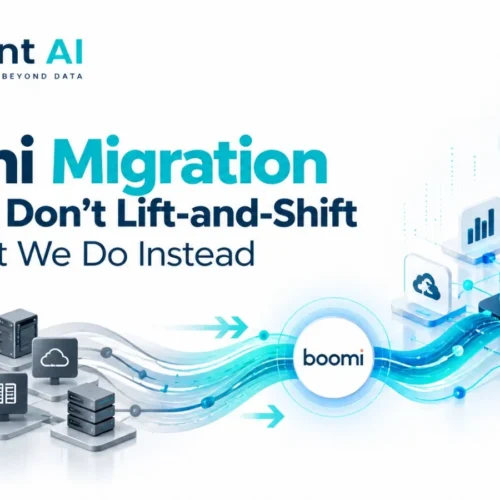
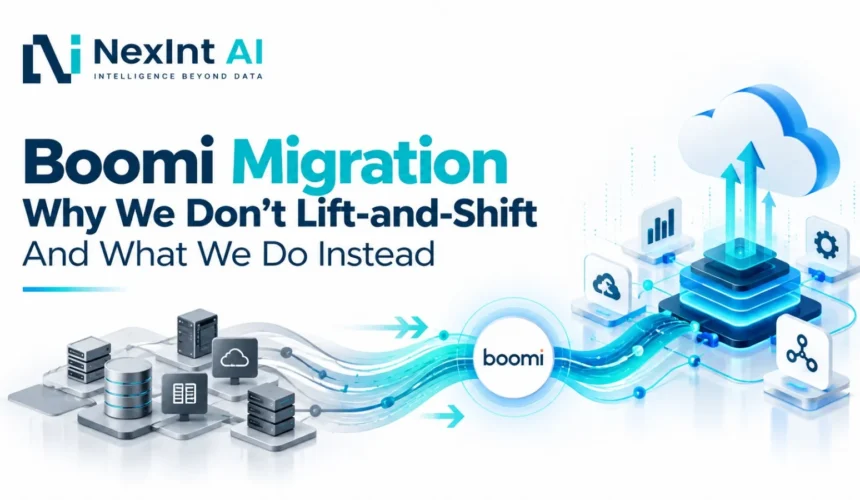
Moving an old integration to a new platform does not automatically modernize it. Sometimes it just gives old technical debt a new address.
The common approach looks like this: legacy integration → rebuild exactly in Boomi → go live.
It feels safer because fewer architectural decisions appear necessary. But copying integrations one-for-one can also preserve duplicate logic, old assumptions, obsolete interfaces, hard-coded configurations, weak recovery patterns, and outdated batch schedules right along with the business value.
The alternative is a more deliberate sequence: understand → classify → retire → consolidate → redesign where needed → build → validate → cut over.
This article walks through what a genuine Boomi migration should involve, and why a thoughtful legacy integration migration rarely means copying everything exactly as it was. It also covers what to look for when evaluating a Boomi implementation partner for that work.
What Is a Lift-and-Shift Boomi Migration?
Lift-and-shift generally means recreating existing integration behaviour on a new platform with minimal architectural change same logic, same structure, same schedule, just running somewhere new. This is one end of the spectrum in any legacy integration migration; genuine reassessment sits at the other.
Lift-and-shift isn’t always wrong. It can be a reasonable choice when the existing integration is simple, the business logic remains valid, the architecture is already sound, time constraints are significant, or a redesign would add little real value. The argument here is against blind lift-and-shift, not against reuse itself.
Why Lift-and-Shift Feels Safer
Organizations gravitate toward it for understandable reasons: the logic is familiar, the design effort looks lower, a one-to-one comparison is easier to explain to stakeholders, there’s pressure to exit old middleware quickly, documentation is often thin, and nobody wants to change business behaviour mid-migration under a tight deadline. The hidden problem is that technical equivalence is not the same as architectural improvement. A Boomi migration can be technically successful while quietly carrying forward years of unnecessary complexity.
Re-platforming vs. Modernizing Integrations
Re-platforming takes an old integration and builds an equivalent new one the objective is simply moving away from the old technology. Modernization starts from the business requirement, re-evaluates the integration design, and builds an appropriate new pattern the objective is moving the business capability while improving maintainability where it’s justified. A real legacy integration migration usually contains both: some interfaces get re-platformed as-is, others get redesigned, and some should disappear entirely.
12 Steps We Follow Instead of Lift-and-Shift
These twelve steps are what a deliberate Boomi migration involves, beyond simply copying processes across:
Step 1 – Inventory the Existing Integration Estate
Before building anything in Boomi, capture what exists: integration name, business purpose, source, target, owner, schedule, trigger, data volume, dependencies, business rules, error handling, criticality, and current usage. Undocumented integrations are common in long-lived environments. You cannot modernize an integration estate you haven’t mapped.
Step 2 – Classify Every Integration before Migrating It
Not every legacy integration deserves a destination in the new environment. Sort each one into retain (still required, well designed), retire (no longer needed), consolidate (multiple integrations solving the same problem), redesign (requirement remains, design should change), or replace (an existing capability covers it better). This classification step is where most of the real value in a thoughtful Boomi migration gets created.
Step 3 – Separate Business Logic from Platform-Specific Logic
Legacy integrations often mix genuine business rules “customers with status X follow process Y” with platform workarounds that exist only because the old middleware couldn’t support the desired interface directly. Migrate the business intent, not every historical implementation detail.
Step 4 – Remove Hard-Coded Configuration
URLs, file paths, database names, environment values, email recipients, schedule-specific values, and credentials shouldn’t be scattered through process logic. Boomi’s environment and deployment model packaging a process and deploying it to a specific environment such as dev, test, or production, running on what current Boomi documentation now calls a runtime supports separating configuration from logic when it’s designed that way from the start.
Step 5 – Standardize Repeated Integration Patterns
Assessment often surfaces repeated logic in authentication, common transformations, notifications, logging, error handling, API interactions, or file-processing patterns. Build reusable components where reuse is genuine but don’t create a complicated shared framework for logic that’s only used once. Standardize repetition, not uniqueness.
Step 6 – Redesign Error Handling Instead of Copying It
Legacy integrations may stop completely on one bad record, ignore failures silently, write errors only to local logs, require manual restarts, or retry indefinitely. For each integration, ask: what can fail, is the failure transient, can processing continue, can failed records be isolated safely, could retry create duplicates, and who should be notified? Failure behaviour is part of the integration design not an exception bolted on after development.
Step 7 – Reconsider Batch vs. API vs. Event Patterns
Don’t automatically reproduce the existing schedule. A legacy job that runs every night might simply reflect what was historically convenient, not what the business needs now. Batch, scheduled synchronization, APIs, event-driven processing, and file-based approaches all have a place the right choice depends on business need, not modernization fashion. Real-time isn’t automatically better.
Step 8 – Build Security into the New Architecture
Migration is a natural opportunity to review authentication, credentials, access, least privilege, sensitive information handling, environment separation, and logging and to remove old practices like embedded credentials where they still exist. Platform-specific security mechanisms should be verified against current Boomi runtime documentation rather than assumed from an older implementation.
Step 9 – Design for Monitoring and Support
A migration is incomplete if the new integrations work but operations can’t support them. Define what gets monitored, what counts as failure, who receives alerts, who owns recovery, what information support needs, and how recurring failures get identified. The migration deliverable isn’t only a functioning process it’s a supportable production integration.
How NexInt AI Solutions Approaches Legacy Integration Migration
NexInt AI Solutions brings Data Engineering expertise to integration modernization work, including the Pipeline Development discipline that underpins reliable data movement between systems. Discovery & Scoping forms the starting point for any migration engagement mapping the existing integration estate and business requirements before any platform decisions get made, with AI Solutions supporting any AI-driven capability that gets layered onto the modernized data flow afterward.
The recommended approach follows discovery → integration inventory → classification → architecture → migration → validation → cutover → stabilization → decommissioning.
The goal isn’t to reproduce technical debt faster on a newer platform it’s to preserve required business behaviour while simplifying and modernizing the architecture where the evidence justifies it. NexInt does not claim official Boomi partner or certification status beyond what is verifiable on its own site, and makes no guarantees about migration duration, cost reduction, or performance outcomes. When evaluating a Boomi implementation partner for this kind of work, the questions above matter more than any marketing claim.
NexInt works with organizations in Chennai, Tamil Nadu, and across India planning a legacy integration migration onto modern platforms like Boomi.
Frequently Asked Questions
01.
1. What is a Boomi migration?
02.
2. What is lift-and-shift integration migration?
03.
3. Should legacy integrations be redesigned during a Boomi migration?
04.
4. How do you migrate legacy integrations to Boomi?
05.
5. What should be assessed before a legacy integration migration?
Conclusion
ITV’s experience proves that digital transformation does not mean building every system connection from scratch. The best approach is to choose what to build and what to buy. This way engineering teams can focus on the parts that truly set the company apart. All the rest can be managed through a controlled integration platform. Media companies, SaaS firms and technology businesses in Chennai, Tamil Nadu and, across India that are struggling with integration backlogs are encouraged to reach out to NexInt AI Solutions . They can help design an integration architecture and operating model that grows with the business. Learn more on the NexInt blog.