30–40% of FDA drug approval delays trace back to non-compliant data — not bad science. We built 5 AI agents that autonomously detect violations, cite exact FDA regulations, and decide submission readiness. Here is the full story.
- 1. The $1–8 Million Problem Nobody Is Talking About
- 2. What Is CDISC and Why Does It Matter?
- 3. The Real Cost of Non-Compliance
- 4. Why Current Tools Are Failing
- 5. Introducing NexClinicalMind
- 6. The 5 Agents — What Each One Does
- → SENTINEL — Pipeline Monitor
- → GUARDIAN — CDISC Validator
- → COUNSEL — The Differentiator
- → REMEDIATE — Auto-fix
- → PACKAGER — Gatekeeper
- 7. Three Real Scenarios — Live Demo
- 8. Before vs After — 9 Metrics
- 9. The 21 CFR Part 11 Audit Trail
- 10. The Market Opportunity
- 11. Technology Stack
- 12. How to Get Started
1. The $1–8 Million Problem Nobody Is Talking About
Every day a pharmaceutical drug approval is delayed, the company behind it loses up to $8 million in revenue. Not because the science failed. Not because the clinical trial produced bad results. Because the data was formatted wrong.
This sounds almost absurd. Billion-dollar drugs — years of research, thousands of patients, hundreds of researchers — held up because a spreadsheet had the wrong column name. A variable called AETERM had NULL values. A date field called ICDTC was missing for 23 subjects.
But it is not absurd. It is the reality of clinical trial data compliance. And it is happening at scale, right now, across every major pharmaceutical company in the world.
The teams responsible for catching these problems are doing it manually. With spreadsheets. Using regulatory specialists who charge $300 an hour. Taking 6 months per submission. Every. Single. Trial.
We built NexClinicalMind to change this entirely. But first, let us understand exactly why this problem exists and why it has been so hard to solve.
2. What Is CDISC and Why Does It Matter?
CDISC — the Clinical Data Interchange Standards Consortium — defines the exact data format the FDA requires for drug approval submissions. Before any new drug can be approved, the sponsor must submit all clinical trial data in a highly specific format called SDTM (Study Data Tabulation Model) and ADaM (Analysis Data Model).
Think of CDISC as the FDA’s data language. Every variable name, every format, every relationship between datasets must conform exactly to CDISC specifications. The FDA uses automated validation software to check this — any violation triggers a rejection or a request for correction that can take months to resolve.
The Most Common CDISC Violations
From our analysis of FDA Complete Response Letters and clinical data management industry reports, the most common violations are:
- Missing AETERM values — The Adverse Event Term field is mandatory in the AE domain. NULL values impair FDA safety signal assessment.
- Missing ICDTC (Informed Consent Date) — Required for every subject in the IC domain. Missing dates raise informed consent compliance questions.
- Non-standard unit codes — Lab results must use CDISC-approved unit terminology in the LB domain.
- Invalid USUBJID format — Unique subject identifiers must follow the exact CDISC specification.
- Missing required variables — Each CDISC domain has mandatory variables. Missing any one blocks submission.
AE (Adverse Events) — Patient safety events during the trial. DM (Demographics) — Subject identification and demographics. LB (Lab Results) — Laboratory test results and units. IC (Informed Consent) — Consent documentation and dates. Each domain has mandatory variables and relationship rules enforced by FDA validation software.
3. The Real Cost of Non-Compliance
These numbers represent a structural inefficiency in pharmaceutical drug development that has existed for decades. The surprising thing is not that the problem is large — it is that almost nothing has been done to automate the solution.
Consider the economics: a single day of delayed approval for a blockbuster drug represents more revenue loss than the entire annual SaaS cost of an automated compliance platform. The ROI on NexClinicalMind is not measured in months. It is measured in days.
The most severe consequence of non-compliance is not just a delayed submission — it is a clinical hold. When the FDA determines that a trial has proceeded without proper informed consent documentation, it can suspend the entire trial. All enrolled subjects must stop treatment. Years of work can be voided. This is not a theoretical risk — it happens every year to trials of all sizes.
4. Why Current Tools Are Failing
The clinical data management market has no shortage of tools. Monte Carlo, Great Expectations, Informatica, Veeva Vault — all offer some form of data quality monitoring. So why is the problem still so severe?
Because every single one of these tools does the same thing: they alert.
When a pipeline fails at 2am, the tool sends an email. A data engineer wakes up, logs in, investigates. They escalate to a regulatory specialist. The specialist manually looks up which CDISC standard was violated and which FDA regulation it breaks. They manually write a remediation brief. They manually obtain sign-off. They manually rerun the pipeline.
This process takes hours to days. It happens dozens of times per trial. Multiplied across 10, 20, or 50 concurrent trials at a global pharma company — the cumulative cost is staggering.
There is also a second, less obvious problem: reactive monitoring. Current tools are used at submission time — when a company has finished a trial and is preparing to send data to the FDA. This is the worst possible time to discover compliance violations. By then, the data has been collected, transformed, and frozen. Fixing violations means reopening datasets, re-running analyses, and revalidating everything.
NexClinicalMind monitors continuously throughout the trial — catching violations the moment they occur, when they are still cheap and easy to fix.
5. Introducing NexClinicalMind
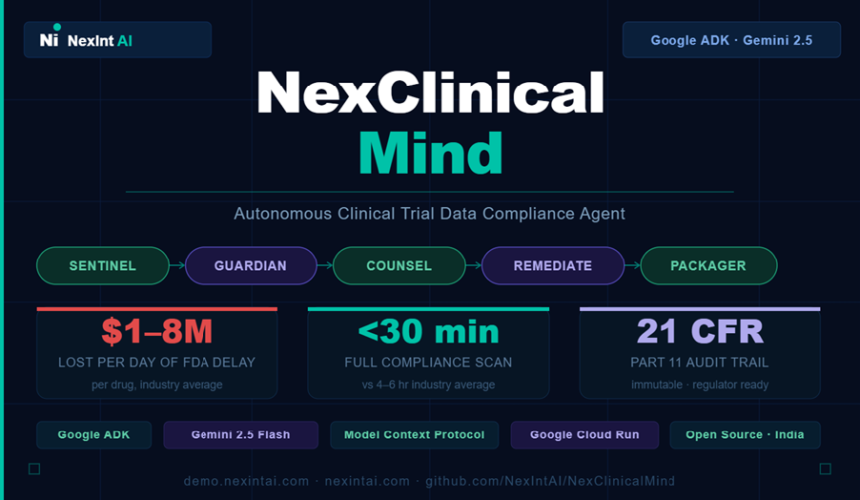
NexClinicalMind is the world’s first autonomous clinical trial data compliance agent. It does not alert. It acts.
Built on Google Agent Development Kit (ADK), Gemini 2.5 Flash, CrewAI, and Model Context Protocol (MCP), NexClinicalMind deploys 5 specialised AI sub-agents that work in sequence — monitoring pipelines, validating data, citing regulations, generating fix plans, and making final submission decisions — all autonomously, all without human intervention.
The system is live right now at demo.nexintai.com. No login required. You can run a full 5-agent compliance scan in under 90 seconds on our demonstration scenarios — or connect your real Airflow, Snowflake, and dbt environment for production monitoring.
6. The 5 Agents — What Each One Does
Each agent has a specific responsibility. They run in sequence — the output of one feeds directly into the next. Together they cover the entire compliance workflow from pipeline monitoring to FDA submission decision.
7. Three Real Scenarios — Live Demo
NexClinicalMind ships with three demonstration scenarios representing the most common compliance failures in clinical trials today. You can run all three right now at demo.nexintai.com — no login required.
Scenario 1 — AE Domain Violation (AETERM NULL Values)
47 clinical trial records are missing the AETERM (Adverse Event Term) field — a mandatory variable in the FDA CDISC SDTM AE domain. SENTINEL detects the upstream schema change in the EHR system that caused the failure. GUARDIAN identifies all 47 affected records. COUNSEL cites FDA 21 CFR 312.32 — IND Safety Reports and generates a remediation brief requiring retrospective data retrieval from source CRFs. PACKAGER blocks the submission. Total scan time: ~62 seconds on demo data.
Scenario 2 — Patient Consent Violation (Missing ICDTC)
23 subjects are missing their ICDTC (Informed Consent Date) in the IC domain — the most serious violation type in clinical trials. Without documented consent dates, these subjects’ data could trigger an FDA clinical hold, potentially invalidating the entire trial. COUNSEL cites FDA 21 CFR Part 50.27 — the exact informed consent documentation requirement. PACKAGER blocks the submission with 3 unresolved violations. Total scan time: ~85 seconds on demo data.
Scenario 3 — Clean Scan (All Checks Pass)
All 4 clinical data pipelines are healthy. All CDISC validation checks pass across AE, DM, LB, and IC domains. Zero violations. PACKAGER makes the final call: Submission Package READY. Package cleared for FDA submission. Full audit trail generated as legal proof. This is the outcome every pharma data team is working towards — and NexClinicalMind reaches it in under 90 seconds.
8. Before vs After — 9 Metrics
| ❌ Before NexClinicalMind | ✅ After NexClinicalMind | |
|---|---|---|
| Detection time | 4–6 hours average | <30 min real data · 24s demo |
| Root cause diagnosis | Manual engineering investigation | Gemini AI — autonomous, instant |
| Regulation lookup | $300/hr specialist — hours | COUNSEL — exact CFR in seconds |
| Remediation brief | Half a day to write manually | Generated autonomously — 30 seconds |
| Submission preparation | 6 months reactive at end of trial | 6 weeks with continuous monitoring |
| Audit trail | Manual documentation | 21 CFR Part 11 automated |
| Submission decision | Human committee — days | Autonomous PACKAGER — seconds |
| Cost per violation | $300/hr specialist time | Included in SaaS subscription |
| Monitoring frequency | Reactive — at submission time only | Continuous — throughout the trial |
9. The 21 CFR Part 11 Audit Trail
21 CFR Part 11 is the FDA regulation that governs electronic records and electronic signatures in clinical trials. It requires that every action on clinical data be logged with a timestamp, attributed to a specific person or system, and stored in a record that cannot be altered after creation.
NexClinicalMind generates a 21 CFR Part 11 compliant audit trail automatically. Every agent action — every pipeline scan, every violation detection, every regulation lookup, every remediation brief, every submission decision — is logged with a unique audit ID, ISO 8601 timestamp, agent attribution, action type, detail, and severity level.
This audit trail is not just a compliance checkbox. It is the legal proof that your compliance process happened. When the FDA asks how you caught a violation and what you did about it — the audit trail is your answer. When a regulator audits your trial — the audit trail is your defence.
10. The Market Opportunity
What makes NexClinicalMind’s market position particularly strong is the absence of direct competition. Existing clinical data management tools monitor data quality — they do not reason about it. They alert — they do not act. And none of them speak FDA. NexClinicalMind is not competing with existing tools. It is creating a new category: autonomous regulatory intelligence.
11. Technology Stack
NexClinicalMind is built entirely on Google’s enterprise AI stack — making it production-grade, auditable, and scalable from day one.
- Gemini 2.5 Flash — Powers autonomous root cause diagnosis, FDA regulation generation, and remediation briefs across all 5 agents
- Google Agent Development Kit (ADK) — Orchestrates the collaborative multi-agent pipeline with graph-based workflows and dynamic decision branching
- Model Context Protocol (MCP) — 6 MCP tools connecting agents to Airflow, Snowflake, dbt, FDA regulations, pipeline reruns, and audit logging over a standardised protocol
- Google Cloud Run — Both the Flask API and MCP server deployed serverlessly — auto-scaling, zero idle cost, pay only when running
- CrewAI — Collaborative multi-agent framework enabling full context handoff between all 5 sub-agents in sequence
- Apache Airflow + Snowflake + dbt — Native connectors for the standard pharma clinical data engineering stack
The entire system is open source — you can explore every line of code at github.com/NexIntAI/NexClinicalMind. This is deliberate. In a regulated industry like pharma, transparency in how your compliance tool makes decisions is not optional — it is essential.
12. How to Get Started
NexClinicalMind is live and accepting early access applications. We are onboarding the first 20 pharma teams personally — configuring the system for your specific Airflow, Snowflake, and dbt environment, running your first real compliance scan together, and supporting you through your first FDA submission cycle.
Early access includes:
- 3 months free access — no payment required
- Personal onboarding by the NexInt AI founding team
- Custom configuration for your data stack
- Priority support through your first FDA submission cycle
- 20% lifetime discount when you convert to paid