
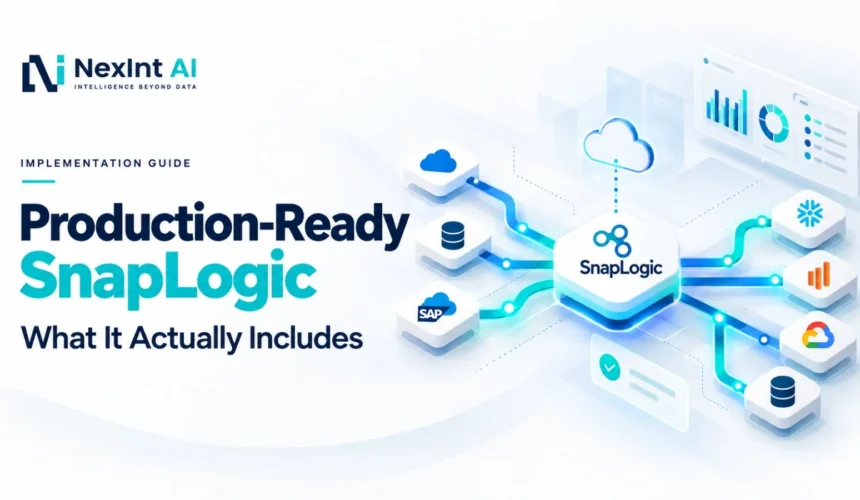
Getting a SnapLogic pipeline to run is not the same as getting SnapLogic ready for production. A proof of concept might successfully read data, transform it, and write it to a target and that’s a real achievement.
But production asks harder questions:
What happens when the source API fails?
What happens when one record is malformed?
Who gets alerted?
Can the pipeline retry safely?
How are credentials managed?
Can another developer understand the pipeline six months from now?
These questions are exactly what separates a working demo from a genuine SnapLogic implementation. Companies evaluating SnapLogic integration services need a clear answer to one question: what should be included when a company pays for a production-ready SnapLogic rollout?
What Is a Production-Ready SnapLogic Implementation?
A production-ready SnapLogic implementation goes beyond building functioning pipelines; it’s what genuine SnapLogic integration services should deliver. It establishes the technical and operational foundation needed to develop, test, deploy, monitor, govern, troubleshoot, maintain, and scale enterprise integrations. A proof of concept asks: can SnapLogic connect these systems? Production implementation asks: can the organization operate these integrations reliably over time?
Integration Architecture Comes Before Pipeline Development
This is the first of fifteen areas a complete SnapLogic implementation needs to address before it’s genuinely production ready. Implementation should start with understanding source and target systems, data volume, integration frequency, latency requirements, and whether the underlying connections involve APIs, files, databases, or SaaS applications. From there, teams choose an appropriate pattern batch, API-based, event-driven, scheduled, file-based, or data synchronization based on the actual requirement, not a default habit. No single architecture is universally best. Start with the integration requirement, then design the pipeline not the other way around.
Environment and Project Structure
Enterprises need deliberate structure rather than pipelines accumulating without organization. SnapLogic’s Project Manager organizes Pipelines, Accounts, Tasks, and Files into Projects and Project Spaces, which can support separation between development, testing, and production work. This structure matters directly for change control, access management, troubleshooting, and release management without it, a growing pipeline library becomes difficult to navigate or safely modify.
Pipeline Design Standards
A production-ready rollout defines standards for pipeline naming, parameter naming, documentation, reusable components, input/output expectations, and error conventions, consistent with official SnapLogic pipeline best practices. In a fragile approach, every developer builds pipelines differently, and knowledge stays trapped in whoever wrote the original logic. In a scalable approach, teams follow common implementation patterns, and consistency reduces how much critical knowledge lives inside any one person’s head.
Reusable Integration Components
Authentication, common transformations, logging, error handling, notifications, and standard API patterns are all strong candidates for reusable components build once where reuse is genuinely real. The important caveat: don’t create abstraction for its own sake. Reusable components should reduce maintenance, not make a simple integration harder to understand than it needs to be.
Production-Grade Error Handling
A pipeline that works when everything is healthy isn’t enough. Production design needs to answer what happens on an API timeout, an authentication failure, an invalid or malformed record, a missing required field, an unavailable target, a missing file, or an unexpected schema. Should the pipeline stop? Retry? Isolate the failed record and continue? Where does the failure get recorded, and who gets notified? Error handling should be designed before production not improvised after the first incident.
Retry and Recovery Strategy
Blindly retrying every failure can create duplicate records, duplicate transactions, increased API load, and hidden problems that resurface later. A sound strategy distinguishes retryable from non-retryable failures, applies backoff where appropriate, considers idempotency, and defines how restart and recovery work when a pipeline fails partway through a run.
Logging, Monitoring, and Alerting
Operations teams need to know whether a pipeline ran, whether it completed, how many records were processed, which records failed, how long execution took, and whether performance is changing over time. SnapLogic’s Monitor application is built for observing pipeline execution and infrastructure health, distinct from logging (what happened) and alerting (who needs to act). If the only way to discover a failed integration is a business user complaining, the implementation isn’t operationally mature yet.
Security, Credentials, and Access Control
Production considerations include credential management, account structure, user access, role-based permissions, least privilege, and environment access. SnapLogic Accounts are designed specifically to store credentials separately from pipeline logic developers shouldn’t need to hard-code sensitive credentials directly into a pipeline. Access across Projects and assets can be controlled through permission models, though the exact configuration should always be verified against current SnapLogic documentation for the organization’s specific setup.
Testing Before Production
A production-ready SnapLogic implementation tests across several layers: functional testing (does it produce the expected result?), data testing (are mappings and transformations correct?), failure testing (what happens when dependencies fail?), volume testing (does it handle realistic workload?), regression testing (did a recent change break existing behaviour?), and permission testing (are access boundaries correct?). A single successful developer test on a handful of records is not equivalent to production testing.
CI/CD and Controlled Deployment
Reliable SnapLogic integration services treat deployment as a repeatable promotion process moving through development, test, approval, and production in a controlled way rather than ad hoc. This covers version control where applicable, deployment automation, release approval, rollback planning, and change traceability. Not every organization needs the same CI/CD design; the right level of formality depends on team size and change frequency.
Performance and Capacity Planning
Data volume, transformation complexity, concurrency, API limitations, source and target performance, pipeline design, and Snaplex sizing all effect throughputs. Cloudplex and Groundplex runtime choices matter depending on whether connectivity needs to reach on-premises systems or stays entirely cloud-based. Performance testing should reflect expected production workload, not a ten-record developer sample.
Documentation and Operational Runbooks
Each integration deserves documentation covering its purpose, source, target, schedule, dependencies, owner, failure behaviour, recovery steps, support contact, and known limitations. This matters most on the day the original developer is unavailable and someone else must troubleshoot a failure at 2 a.m. A production-ready rollout supports operations, not only development.
Governance and Ownership
Clear answers are needed for who can build pipelines, who reviews them, who can deploy to production, who owns incidents, who approves new connections, who maintains shared components, and who retires obsolete integrations. Governance should match organizational scale; a five-person team doesn’t need the same process overhead as a five-hundred-person integration Center of Excellence. The goal is repeatability and accountability, not slowing delivery down for its own sake.
How NexInt AI Solutions Approaches SnapLogic Implementation
NexInt AI Solutions brings Data Engineering expertise to SnapLogic implementation work building the reliable data foundations and pipeline logic that integration projects depend on.
This includes structured discovery, architecture design, pipeline development, error handling, testing, controlled deployment, monitoring setup, documentation, and operational handover, following the same lifecycle outlined above rather than stopping at “the pipelines run.”
A published SnapLogic integration blueprint illustrates the kind of governance standards and error-handling patterns this approach applies in practice. AI Product Development supports teams building broader products around integrated data, and AI Solutions covers the layer where integrated data feeds AI-driven workflows.
NexInt does not claim official SnapLogic partner or certification status beyond what’s verifiable on its own site, and makes no uptime, performance, or savings guarantees. The focus stays on delivering a genuine production-ready SnapLogic rollout architecture, standards, resilience, and operational ownership for organizations in Chennai, Tamil Nadu, and across India building enterprise integration capability.
Frequently Asked Questions
01.
1. What does a SnapLogic implementation include?
02.
2. How do you implement SnapLogic for production?
03.
3. What makes a SnapLogic pipeline production-ready?
04.
4. What should SnapLogic integration services include?
05.
5. How should SnapLogic pipelines handle errors?
Conclusion
A successful SnapLogic implementation is not measured by whether a pipeline runs once. It’s measured by whether the integration can keep running, fail predictably, recover safely, be monitored, be changed, and be supported in production. That means architecture, standards, pipelines, error handling, security, testing, deployment, monitoring, documentation, and ownership working together not as separate afterthoughts, but as one connected operating model.
Production readiness is an operating model, not a final deployment checkbox. Organizations in Chennai, Tamil Nadu, and across India planning a production-ready SnapLogic rollout can work with NexInt AI Solutions on the data engineering and integration foundation this requires. Contact NexInt AI Solutions to discuss your SnapLogic integration service’s needs.