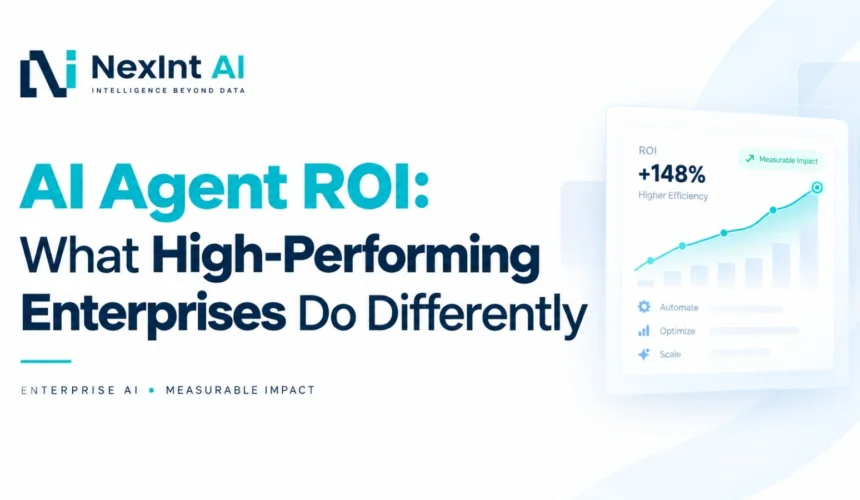
Boards have stopped asking whether AI works. Boards now want proof of AI Agent ROI. A number that shows what came back for the investment. Most enterprises already run copilots, AI pilots and a handful of agent prototypes. Production value however is uneven: some programs pay for themselves inside a year while many others stay stuck as experiments.Two sets of enterprise Agentic AI ROI research capture this tension. PagerDutys 2025 survey of executives shows very high confidence in agentic AI. Google Clouds research shows many organizations already reporting payback from AI agents in production.Yet Deloittes 2026 research finds that a few companies have scaled agent adoption in a coordinated way and that data, governance and integration remain the main blockers. The question this article answers and the one that really drives Enterprise AI ROI is what separates enterprises that turn AI agents into financial results from those still stuck in pilot mode.
171%. What It Actually Means
PagerDuty asked Wakefield Research to survey 1,000 director‑level or higher IT and business leaders at companies with AI Agent ROI of more than $500 million in annual full release revenue in the U.S. U.K., Australia and Japan. The full report shows that 62 percent of those leaders expect more than 100 percent return from Agentic AI and the average expected return is 171 percent worldwide and 192 percent in the U.S. Companies.That difference is important. Agentic AI ROI is a guess, not a result. It shows confidence, not proof that real deployments have already earned that amount. Treating expected Agentic AI ROI as Agentic AI ROI is one of the quickest ways to lose trust, with a CFO who wants numbers that stand up to a close look.
The Useful Number: How Fast Companies See Returns
Google 2025 ROI of AI report is more realistic. Among the executives whose organizations report AI-agent returns 74 percent say they achieved ROI within the year and 52 percent report enterprise AI ROI agents already running in production.Time-to-value matters: a program that takes five years to prove financial value behaves nothing like a bounded workflow that shows measurable gains, inside six to twelve months. Payback period, deployment cost, ongoing operating cost and productivity gains all belong in every Enterprise AI ROI conversation, not the headline percentage.
Why High ROI Is Not the Norm
I read Deloittes 2026 study on transformation and it shows a very different picture from the hopeful tone often heard. Few companies say that their processes are ready for AI agents.Even fewer have rolled out AI agents across teams. Seventy‑two percent say that broken ungoverned data stops them. Many also AI Agent ROI say that weak governance and high integration costs block progress.PwCs 2026 work says something: the benefit of AI is found in a few firms, not all. The clear message is simple: a high ROI from Enterprise AI can happen, it does not happen automatically and it is not just about how good the model is.
What High‑Performing Organizations Do Differently
Across this research five patterns separate programs that produce value from those that do not:
- Narrow scope. They choose one high‑value workflow “reduce time to resolve invoice exceptions” instead of “build an AI agent for Finance.”
- Reliable data. They fix data quality and access before blaming the model. An AI Agent built on duplicate, stale or poorly permissioned data will confidently automate the answer.
- A measurable baseline. They record existing cost, time, volume and error rates before deployment so that before‑and‑after comparisons can be made.
- Production‑grade governance. Permissions, action limits, human approval steps and monitoring are built in from day one not added
- Workflow redesign. They change how the work happens by adding an AI draft to an already inefficient process.
You will notice that Agentic AI ROI together with these patterns support one idea: AI Agent ROI comes from workflow economics not from model capability alone. A useful working formula is AI ROI = (Verified Business Value Total AI Cost) ÷ Total AI Cost × 100. And both sides of that equation must be things you can actually measure.On the cost‑reduction side some industry forecasts point to operational‑cost reductions as agentic systems mature. Your enterprise AI ROI should treat those numbers as forecasts not as results that happen everywhere actual outcomes depend a lot, on the workflow, the data foundation and how disciplined the rollout is.
A Practical ROI Plan
Getting results from research needs a way to get return on investment for Enterprise AI:
- Choose one expensive high-volume process that has real money problems.
- Find out how much it costs, how long it takes, and how much it is. How good it is.
- Set the limits clearly: who uses it, what comes in what needs to be done and what comes out.
- Check the data the system will need and fix what is not working.
- Pick the way to solve the problem. Don’t create an agent if a simple automation would work.
- Set the rules for access: who can read, who can suggest, who can write, who can act and who can ask for help.
- Make the version that can be used in real situations and test it with real difficult cases.
- Look at the money and results before and, after honestly then grow only what actually works.
- Begin with one process, not a full company-wide agent plan.
How NexInt AI Solutions Helps
NexInt AI Solutions does Agentic AI ROI not promise returns. No honest company should. What it does is help companies create the environment where AI Agent ROI can be measured.That environment enterprise AI ROI includes a controlled database through Data Engineering, systems that are limited and clearly defined through AI Solutions, and a careful way to take ideas all the way to production through AI Product Development. . For businesses in Chennai, Tamil Nadu and all over India that are moving from AI trials to use, that mix.Being ready, with data keeping things simple, having rules and being able to track progress. Is what makes AI Agent ROI real instead of just something people talk about?
Conclusion
The headline numbers around AI are Agentic AI ROI encouraging but they are not guarantees. A 171 percent expected return tells executives that agentic AI opportunity is real; it does not tell your organization that agentic AI will happen automatically.
The stronger lesson from this research is Agentic AI ROI operational: choose the workflow, set a baseline, fix the data, build the smallest useful agent, govern agentic AI, measure cost per outcome and scale only what works. The difference between hopeful projection and real enterprise AI ROI. Talk to NexInt AI Solutions , about building that foundation for your AI agent project.