“The companies that win with AI won’t necessarily build the best models. They’ll build the fastest AI-powered businesses.”
Think about that for a second.
A few years ago, Artificial Intelligence was something only tech giants with billion-dollar budgets could afford. Today, a startup with five employees can access the same class of AI capabilities through the cloud in minutes.
That’s not just technological progress.
That’s a complete shift in how businesses compete.
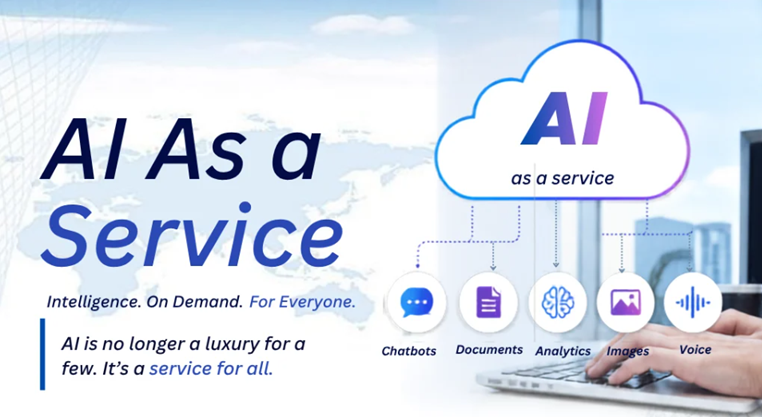
Welcome to the era of AI as a Service (AIaaS).
So, What Exactly Is AI as a Service?
Imagine you need electricity.
You don’t build a power plant—you plug into the grid.
AI is heading in the same direction.
Instead of spending years developing machine learning models, investing in expensive GPUs, and hiring large AI research teams, businesses can now consume AI through APIs and cloud platforms.
Whether it’s:
- Intelligent chatbots
- Document processing
- Predictive analytics
- Image generation
- Voice assistants
- Recommendation engines
- AI agents
- Enterprise search
…companies simply integrate AI into their existing applications and start delivering value.
That’s AI as a Service.
Why AIaaS Is Changing Everything
Here’s what makes AIaaS different from previous technology waves.
Cloud computing changed where we run applications.
AIaaS changes how applications think.
Instead of software waiting for instructions, software can now:
✔ Understand language
✔ Analyze documents
✔ Generate reports
✔ Write code
✔ Detect anomalies
✔ Assist employees
✔ Automate customer support
✔ Make recommendations
This isn’t automation.
This is intelligence on demand.
The Biggest Opportunity? Democratization.
For years, AI belonged to organizations with deep pockets.
Today?
A small healthcare startup can build an AI-powered diagnosis assistant.
A manufacturing company can predict equipment failures.
A law firm can summarize thousands of legal documents.
A retailer can create personalized shopping experiences.
A logistics company can optimize delivery routes using AI.
The barrier isn’t technology anymore.
It’s imagination.
But Here’s the Catch…
Many organizations believe adopting AI means integrating an API and calling it a day.
It doesn’t.
The biggest challenge isn’t choosing the AI model.
It’s preparing the business.
Challenge #1 — Your AI Is Only as Smart as Your Data
Garbage in.
Garbage out.
No matter how advanced the AI model is, poor-quality, outdated, or fragmented data will produce unreliable results.
This is why Data Engineering has become one of the most valuable disciplines in AI.
Without clean, governed, and accessible data…
AI becomes expensive guesswork.
Challenge #2 — Cost Can Scale Faster Than Value
Many organizations rush into AI projects.
Few monitor:
- Token usage
- GPU costs
- API requests
- Model latency
- Infrastructure expenses
An AI solution that saves 10 minutes but costs thousands of dollars every month isn’t innovation.
It’s technical debt wearing an AI badge.
Challenge #3 — Security Isn’t Optional
Enterprise AI doesn’t work with generic public information.
It works with:
- Customer records
- Financial data
- Internal documents
- Contracts
- Medical reports
- Intellectual property
Without proper governance, access control, encryption, and monitoring…
AI becomes a security risk.
Challenge #4 — Trust Is Harder Than Intelligence
Employees won’t use AI they don’t trust.
Customers won’t believe answers they can’t verify.
Executives won’t invest in AI that can’t explain itself.
Transparency is becoming just as important as accuracy.
This is why techniques like Retrieval-Augmented Generation (RAG), audit trails, citations, and human-in-the-loop workflows are becoming standard practices for enterprise AI.
The Companies That Will Win
The winners won’t simply have AI.
They’ll have:
✅ Reliable data pipelines
✅ Strong governance
✅ Scalable cloud infrastructure
✅ Continuous monitoring
✅ Responsible AI practices
✅ Employees who know how to collaborate with AI—not compete against it
AI isn’t replacing businesses.
It’s amplifying the businesses that are already well-structured.
One Thought Worth Remembering
Every major technology shift follows the same pattern.
Those who wait for perfection usually arrive after the market has moved on.
Those who experiment early learn faster.
Those who learn faster build better products.
And those who build better products become the market leaders.
AI as a Service isn’t just another cloud offering.
It’s becoming the operating system of modern business.
The question is no longer:
“Should we adopt AI?”
The real question is:
“How quickly can we build a business that’s ready for AI?”
Because in the coming years, the biggest competitive advantage won’t belong to the companies with the smartest AI.
It will belong to the companies that know how to use at its best.