Introduction
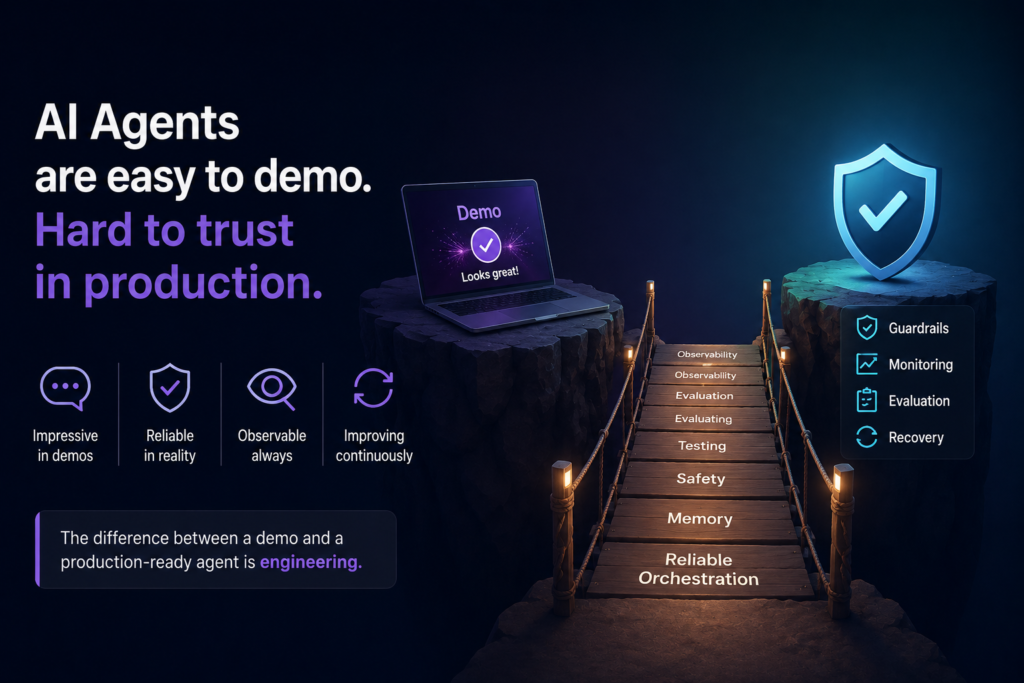
The AI industry is experiencing a massive shift toward Agentic AI. Every day, organizations are building AI agents for customer support, sales, finance, healthcare, research, and business automation. The demonstrations are impressive agents can analyze documents, call APIs, retrieve data, generate reports, and perform tasks that previously required human intervention.
However, there is a significant gap between a successful demo and a production-ready AI system. While building an AI agent has become relatively straightforward, engineering a reliable, scalable, and trustworthy agentic system for real-world environments remains one of the biggest challenges in modern software engineering.
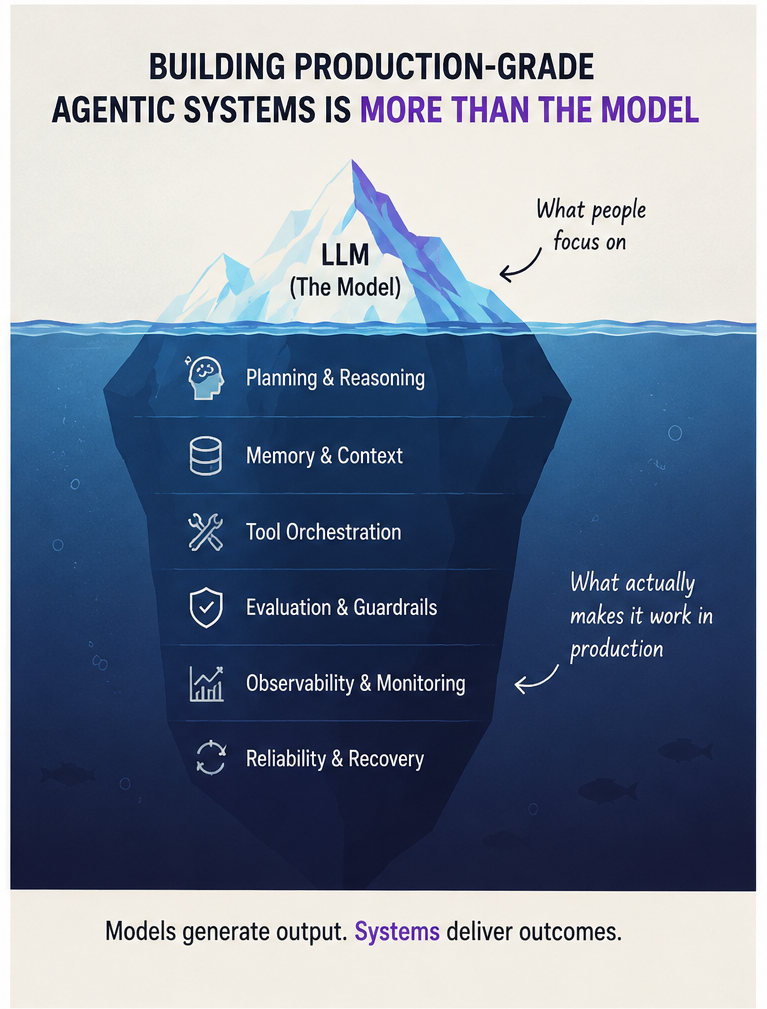
The primary issue isn’t the language model itself. Instead, it lies in the surrounding architecture, evaluation strategies, monitoring, and reliability mechanisms that determine whether an AI system can consistently deliver business value.
The Biggest Misconception About Agentic AI
One of the most common misconceptions in today’s AI landscape is the belief that:
LLM + Tool Calling = AI Agent
This assumption is misleading.
Calling external tools does not automatically create an intelligent agent. Traditional software systems, automation scripts, workflow engines, and microservices can all invoke APIs and execute predefined tasks.
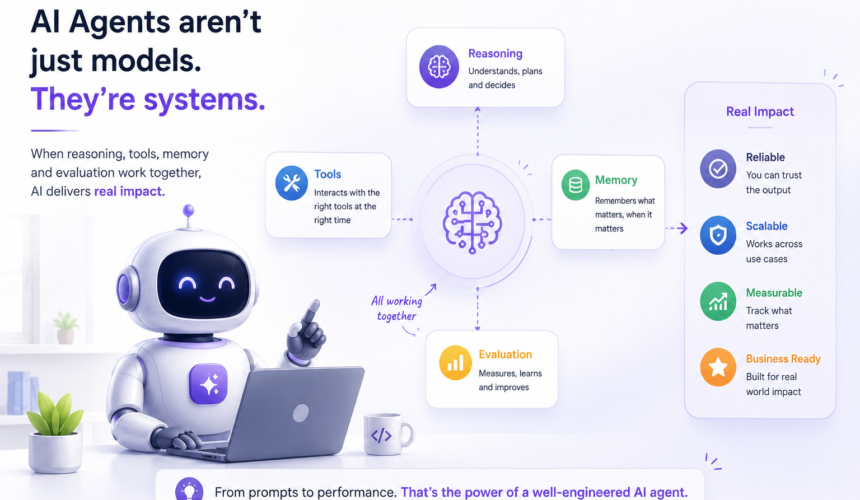
A true AI agent possesses capabilities far beyond simple tool execution. It should be able to:
- Plan actions
- Reason through problems
- Make decisions
- Adapt to changing environments
- Recover from failures
- Pursue goals despite uncertainty
Without these capabilities, the system is simply an automated workflow enhanced by an LLM—not a genuine autonomous agent.
Why AI Agent Demos Look Impressive
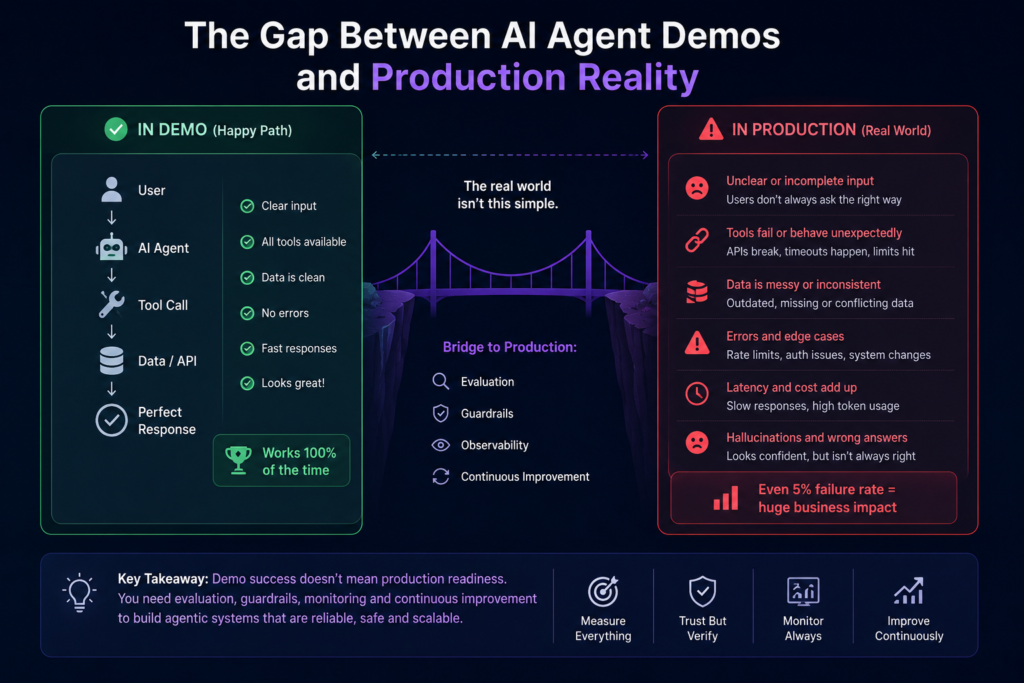
Most AI demonstrations operate under ideal conditions where:
- The task is already known
- The expected outcome is predetermined
- Available tools are carefully selected
- The execution follows a predefined happy path
Real-world production environments are entirely different.
Production systems must handle:
- Incomplete user requests
- Inconsistent database records
- API failures
- Authentication expiration
- Network latency
- Changing business rules
- Third-party service outages
An agent that performs exceptionally well in demonstrations may fail repeatedly in production.
For example, an agent with a 95% success rate may sound impressive. However, when executed 10,000 times per day, that still results in 500 failures daily, which can significantly impact business operations.
Ultimately, production AI is not measured by intelligence alone it is measured by reliability.
Failure Mode 1: Hallucinations Never Completely Disappear
Many organizations assume that fine-tuning a model will eliminate hallucinations.
Unfortunately, hallucinations are an inherent characteristic of probabilistic language models.
Every major model including GPT, Gemini, Claude, Llama, and Mistral can generate incorrect or fabricated information.
The objective is not to completely eliminate hallucinations but to reduce their impact on business operations.
Production systems accomplish this through engineering practices such as:
- Retrieval-Augmented Generation (RAG)
- Tool verification
- Human approval workflows
- Structured outputs
- Confidence scoring
- Knowledge graphs
- Validation pipelines
Successful AI systems are designed to detect, constrain, and recover from hallucinations rather than assuming they can be removed entirely.
Failure Mode 2: Fine-Tuning Everything
When an AI agent performs poorly, many teams immediately consider fine-tuning the model.
While fine-tuning is valuable for:
- Domain-specific terminology
- Response formatting
- Classification tasks
- Organizational writing styles
It does not automatically improve:
- Logical reasoning
- Planning capabilities
- Tool selection
- Long-term memory
- Multi-step execution
Many production issues are not caused by weak language models but by weak system architecture.
The surrounding infrastructure—not just the model—determines production success.
Failure Mode 3: Hyperparameters Become Business Decisions
Hyperparameters such as:
- Temperature
- Top-P
- Frequency Penalty
- Presence Penalty
- Maximum Tokens
- Context Window
are often treated as development settings.
In production environments, these become business-critical decisions.
For example:
- High temperature may generate creative but inconsistent customer responses.
- Extremely low temperature may produce predictable but overly rigid outputs.
Small configuration changes can dramatically alter user experience, consistency, and operational cost.
Production AI requires continuous tuning and monitoring rather than one-time configuration.
Failure Mode 4: Tool Calling Does Not Scale Automatically
Connecting one tool to an AI agent is relatively simple.
Challenges begin when organizations integrate dozens of tools.
The agent must determine:
- Which tool should be used
- When it should be invoked
- In what sequence
- Whether multiple tools are required
- Whether tool outputs can be trusted
As the number of available tools increases:
- Latency increases
- Operational cost increases
- Routing complexity increases
- Failure rates increase
The challenge shifts from tool execution to intelligent decision-making.
Tool calling alone does not represent intelligence.
Correct tool selection does.
Failure Mode 5: Memory Is More Difficult Than Expected
Memory is one of the defining capabilities of agentic systems.
However, implementing effective memory is far more complex than simply storing information.
The real challenge is retrieving the correct information at the appropriate moment.
Robust production memory requires:
- Vector databases
- Semantic search
- Knowledge graphs
- Context compression
- Session management
- Long-term memory architecture
Without these components, agents become increasingly inconsistent as conversations and workflows become more complex.
Failure Mode 6: Lack of Proper Evaluation
Traditional software engineering relies heavily on testing.
Organizations routinely test:
- APIs
- Databases
- Infrastructure
- Security
- Performance
However, many AI systems are still evaluated manually by asking a few questions and checking whether the responses appear reasonable.
This approach is insufficient for production AI.
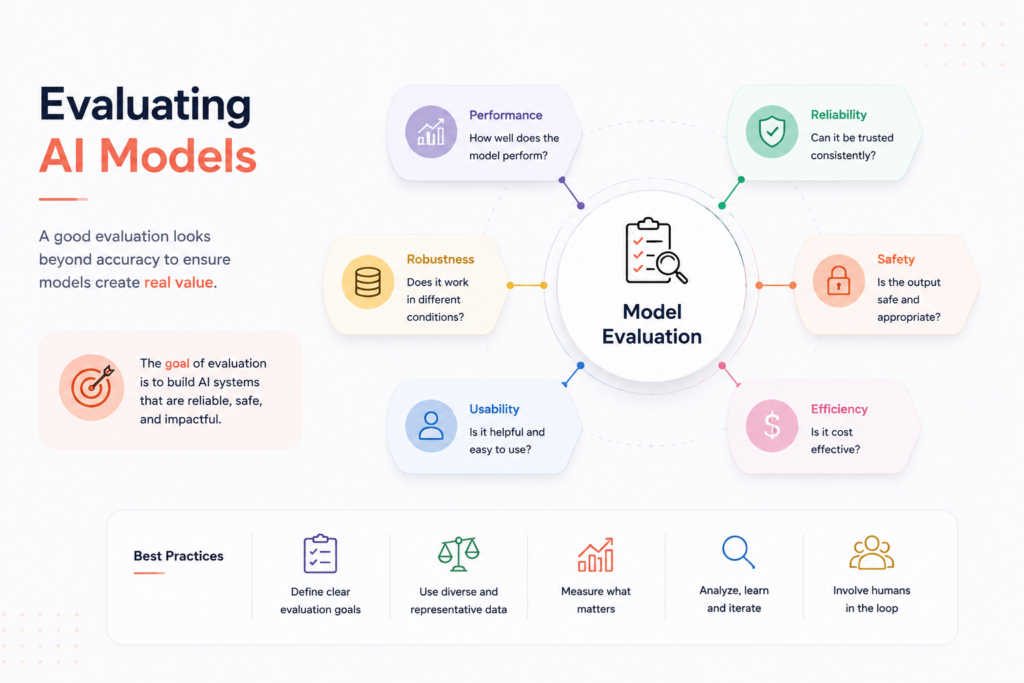
Reliable agentic systems require measurable evaluation metrics, including:
- Task Success Rate
- Tool Selection Accuracy
- Planning Quality
- Response Latency
- Token Cost
- Recovery Rate
- Safety and Trustworthiness
Without measurable metrics, continuous improvement becomes impossible.
The Rise of Agent Reliability Engineering (ARE)
As AI systems become increasingly integrated into business operations, the industry is moving toward a new engineering discipline:
Agent Reliability Engineering (ARE)
Similar to how software engineering evolved into DevOps and Site Reliability Engineering (SRE), AI engineering is evolving toward practices that prioritize operational reliability.
Agent Reliability Engineering focuses on:
- Observability
- Evaluation
- Governance
- Monitoring
- Reliability
- Failure Recovery
Rather than simply building more intelligent agents, organizations must build systems that are dependable, measurable, and trustworthy.
Key Takeaways
Building an AI agent is only the beginning.
The real challenge lies in engineering systems that perform consistently under real-world conditions. Production-ready agentic systems require much more than selecting a powerful language model. They demand robust architecture, continuous evaluation, intelligent memory management, effective tool orchestration, safety mechanisms, monitoring, and recovery strategies.
Organizations that prioritize reliability over novelty will gain the greatest long-term value from Agentic AI.
Conclusion
The future of AI belongs not to the companies with the largest number of agents, but to those whose agents consistently deliver reliable, safe, and measurable outcomes.
As AI adoption accelerates, success will no longer be defined by impressive demonstrations. Instead, it will be determined by how effectively AI systems operate in production environments where uncertainty, failures, and changing conditions are inevitable.
In the coming years, Agent Reliability Engineering will become as essential to AI as DevOps is to modern software development. The organizations that invest in evaluation, monitoring, governance, and continuous improvement today will be the ones that build AI systems businesses can genuinely trust.